Every artery
Estimates for all the vessels of one body laid end to end run to about 100,000 kilometres, and nearly all of that length is capillaries too fine to see. The model shows the arterial tree down to branches a few millimetres wide, each generation narrower and more numerous than the last.
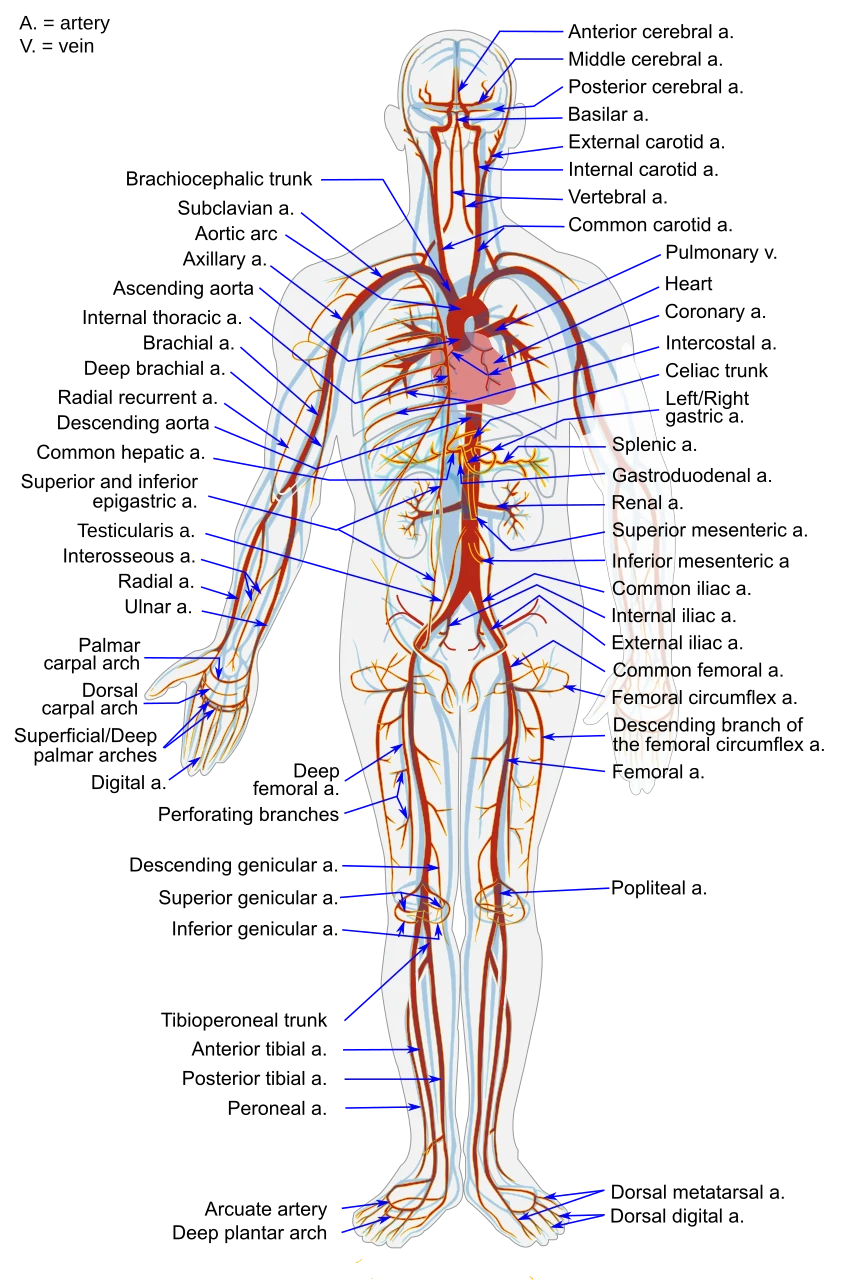 The main arteries of the body from the frontWikimedia Commons, Mariana Ruiz Villarreal (LadyofHats), Public domain (Arterial System en.svg)
At any moment the arteries hold only about an eighth of the blood. Their walls are thick and muscular, and the smallest, the arterioles, can narrow or widen on signals from nerves and hormones.
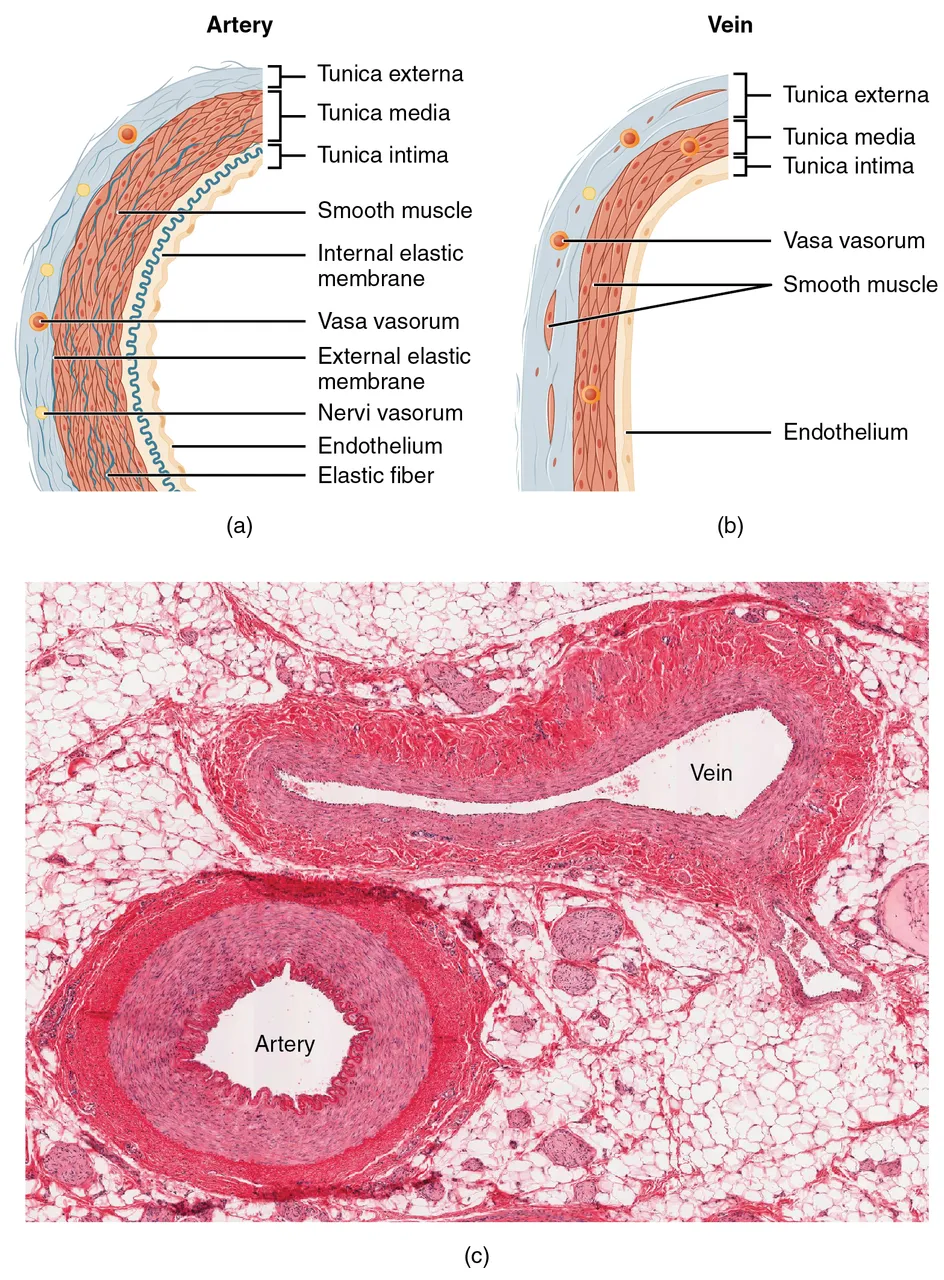 The walls of an artery and a vein, drawn and in a micrograph: the artery's thick layer of smooth muscle and elastic fibres against the vein's thinner wall, OpenStax Anatomy and PhysiologyWikimedia Commons, OpenStax College, CC BY 3.0 (2102 Comparison of Artery and Vein.jpg)
This is how the body sends more blood to the muscles in a run and to the gut after a meal, and how it sets the blood pressure as a whole.
Sources
- Arthur Guyton and John Hall, Textbook of Medical Physiology, 13th ed. (2016), ch. 14 and 17.
- Susan Standring (ed.), Gray's Anatomy, 42nd ed. (2020), ch. 6.
Prev: Below the kneeNext: Capillaries