1628
The bandaged arm
William Harvey, a London physician, set out his proof in 1628 in a book of 72 pages, De motu cordis. One of his tests needed only a bandage. He tied it round a man's upper arm, tight enough to stop the blood in the veins but not in the deeper arteries.
Below the bandage the veins of the forearm swelled: the cephalic on the thumb side, the basilic on the side of the little finger and the median cubital between them at the elbow. Small knots showed where their valves sat.
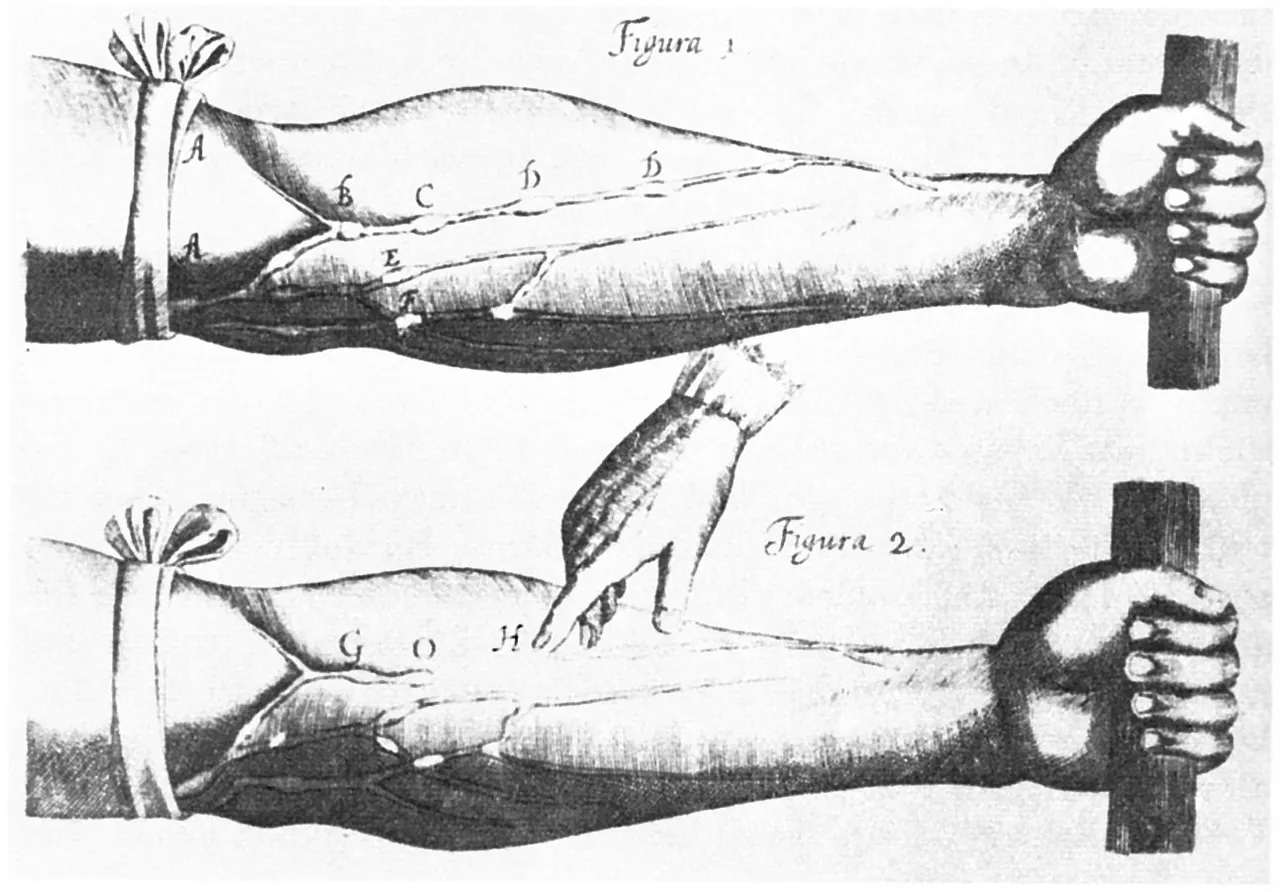 The bandaged arm and the valves of the veins, William Harvey, De motu cordis, 1628Wikimedia Commons, William Harvey, Public domain (William Harvey ( 1578-1657) Venenbild.jpg)
He pressed one finger on a swollen vein and with another pushed the blood up past the next valve. The stretch between stayed empty, because no blood came back down through the valve. When he lifted the lower finger, it filled at once from below. Blood could pass the valves only towards the heart.
Sources
- William Harvey, Exercitatio anatomica de motu cordis et sanguinis in animalibus (1628), ch. 11 and 13.
Prev: Ibn al-NafisNext: Harvey's sum