Blood pressure
Blood pressure is usually measured on the brachial artery, with the arm at the height of the heart. A cuff round the upper arm is pumped up until it squeezes the artery shut. It is then let down slowly while a stethoscope listens over the artery at the elbow.
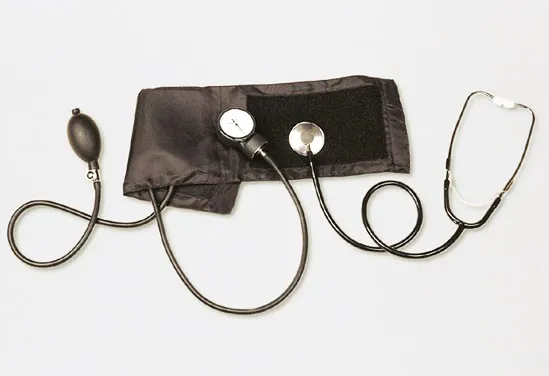 A blood pressure cuff with its pump and gauge, and a stethoscopeWikimedia Commons, United States government, Public domain (Sphygmomanometer.jpg)
When the cuff pressure falls just below the peak pressure of each beat, blood spurts through and makes a tapping sound. That reading is the systolic pressure, about 120 millimetres of mercury in a healthy young adult. When the sounds stop, the cuff no longer narrows the artery. That is the diastolic pressure, about 80.
The cuff is Scipione Riva-Rocci's, from 1896, and the sounds were described by Nikolai Korotkov in 1905. Along the circulation the pressure falls, to about 35 at the start of the capillaries, 10 at their end and close to zero in the right atrium.
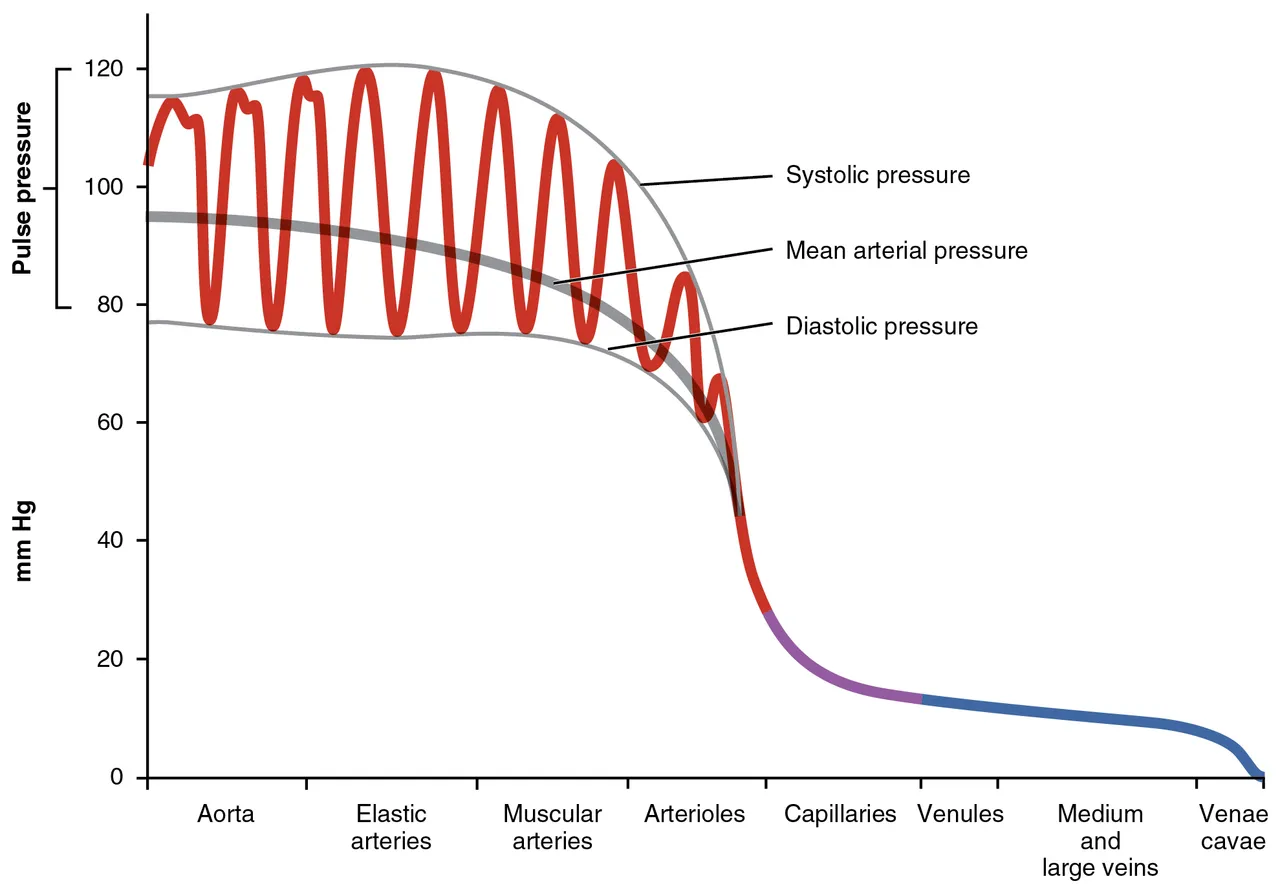 The blood pressure along the circulation, from the aorta through the arteries, arterioles, capillaries and veins to the venae cavae, OpenStax Anatomy and PhysiologyWikimedia Commons, OpenStax College, CC BY 3.0 (2109 Systemic Blood Pressure.jpg)
Sources
- Arthur Guyton and John Hall, Textbook of Medical Physiology, 13th ed. (2016), ch. 14 and 15.
- Scipione Riva-Rocci, Un nuovo sfigmomanometro, Gazzetta Medica di Torino 47 (1896).
Prev: The armNext: The gut