Capillaries
Capillaries are the narrowest vessels, about 5 to 10 micrometres across, so red cells pass in single file and often bend to fit. Their wall is a single layer of thin flat cells. Oxygen, food and wastes pass through it between the blood and the fluid around the cells.
Each capillary is half a millimetre to a millimetre long, and the body has some 10 billion of them. Blood slows to about a third of a millimetre a second inside them, so it takes one to three seconds to cross.
In the hand the model's arteries end in the palmar arches and its veins begin in the network on the back of the hand. Between them, too small for the model, lie the capillaries of the skin, muscles and bones of the hand.
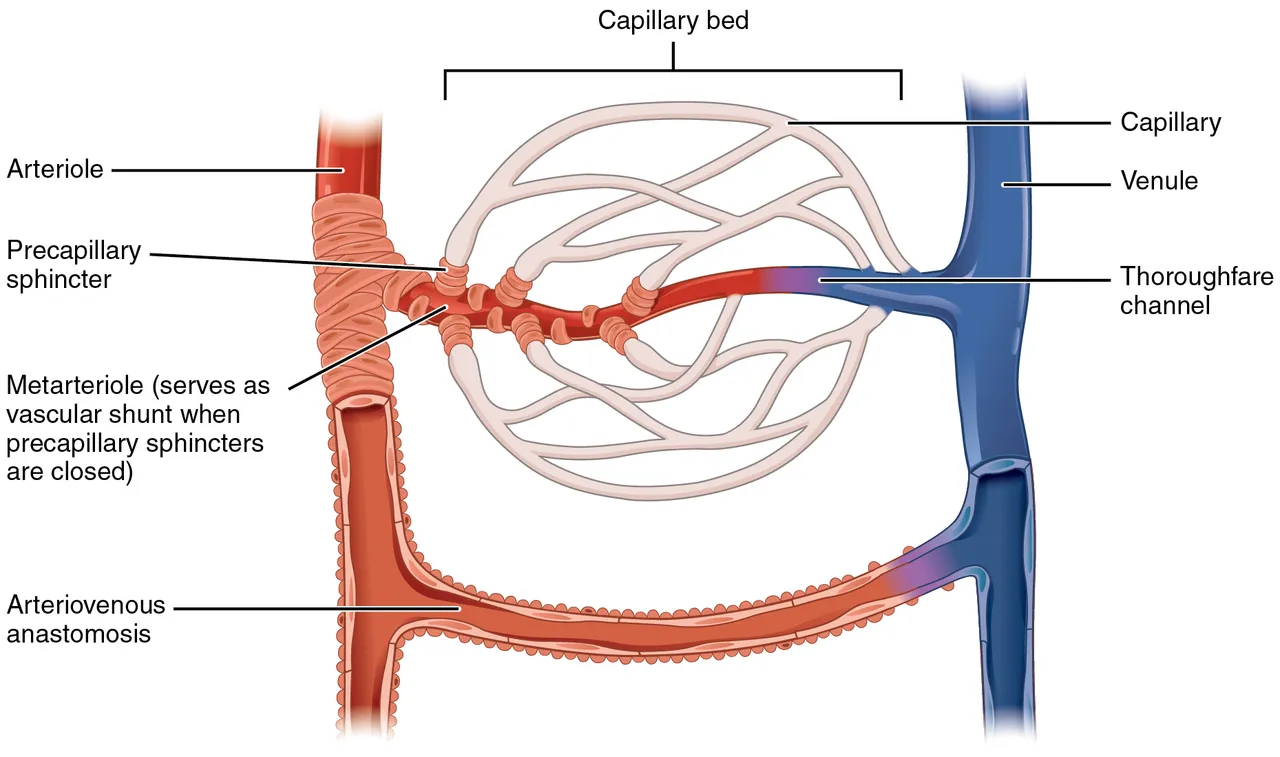 A capillary bed between an arteriole and a venule, OpenStax Anatomy and PhysiologyWikimedia Commons, OpenStax College, CC BY 3.0 (2105 Capillary Bed.jpg)
Sources
- Arthur Guyton and John Hall, Textbook of Medical Physiology, 13th ed. (2016), ch. 16.
- Susan Standring (ed.), Gray's Anatomy, 42nd ed. (2020), ch. 6.
Prev: Every arteryNext: The venae cavae