Where blood ends
A red cell has no nucleus and cannot repair itself. After about 120 days its membrane has stiffened. To leave the pulp of the spleen, a cell must squeeze through slits narrower than itself, and a stiff one gets stuck and is eaten by the macrophages waiting there.
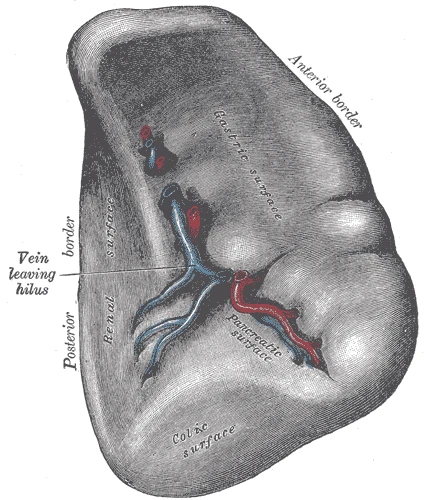 The spleen and its vessels, Gray's Anatomy, 1918, figure 1188Wikimedia Commons, Henry Vandyke Carter, Public domain (Gray1188.png)
The macrophage takes the haemoglobin apart. The iron is bound to a carrier protein and returned to the marrow, so the body loses only a milligram or two a day. The rest of the haem becomes bilirubin, a yellow pigment that travels in the splenic and portal veins to the liver.
The liver takes bilirubin out of the blood and passes it into the bile and so into the gut, where its products colour the stool brown. When the liver fails, or cells break down faster than it can clear them, bilirubin builds up and turns the skin yellow.
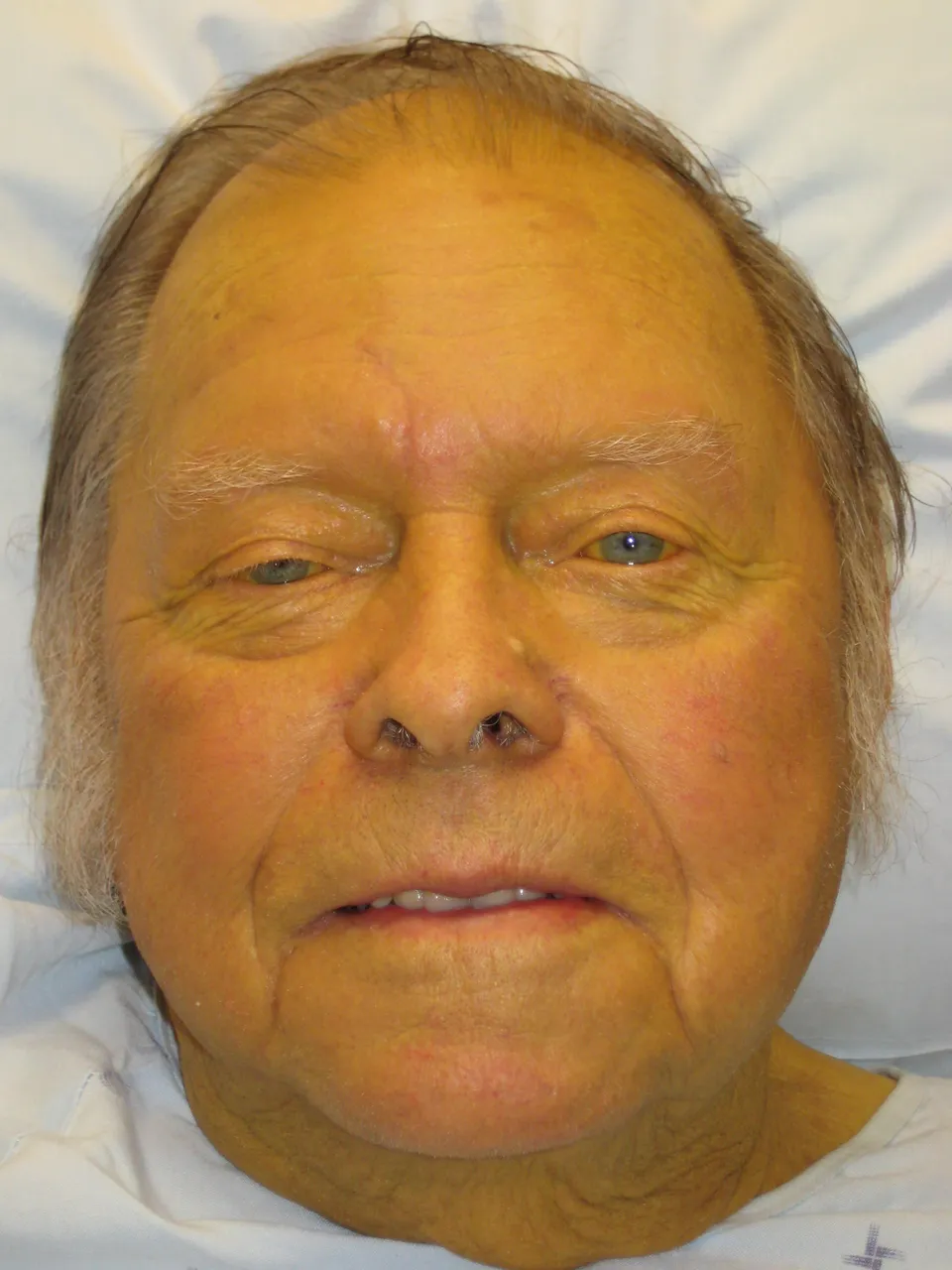 Jaundice: bilirubin colours the skin and the whites of the eyes yellowWikimedia Commons, James Heilman, CC BY 3.0 (Jaundice08.jpg)
Sources
- Arthur Guyton and John Hall, Textbook of Medical Physiology, 13th ed. (2016), ch. 33 and 71.
- Susan Standring (ed.), Gray's Anatomy, 42nd ed. (2020), ch. 4 and chapter on the spleen.
Prev: Where blood is madeNext: Galen