Before the first breath
Before birth the lungs are filled with fluid and do no breathing. Oxygen comes from the placenta, through the umbilical vein in the cord. Most of this blood bypasses the liver through a short channel, the ductus venosus, and reaches the right atrium through the inferior vena cava.
Two shortcuts let most of the blood skip the lungs. A hole with a flap in the wall between the atria, the foramen ovale, lets blood pass from the right atrium straight into the left atrium. Most of the blood that does reach the pulmonary trunk is turned into the aorta through a short vessel, the ductus arteriosus.
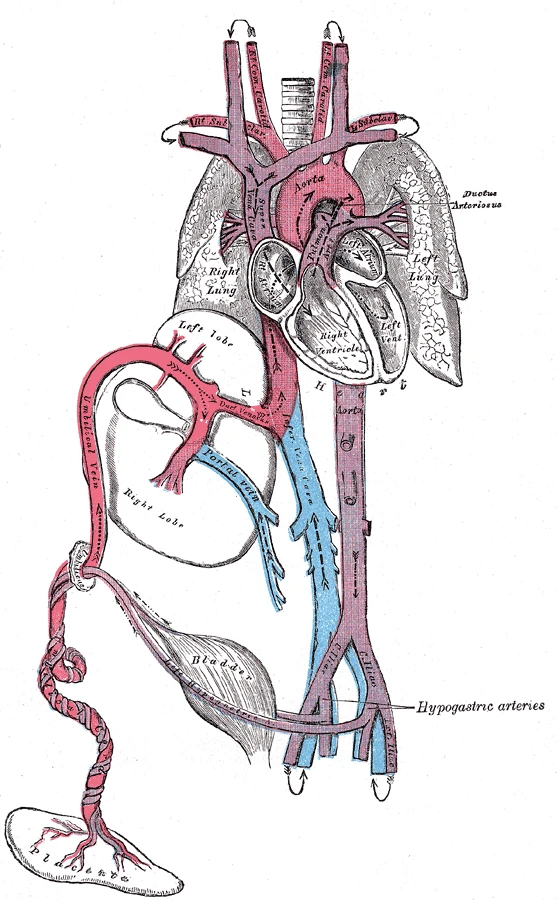 The circulation before birth: the umbilical vein from the placenta, the ductus venosus through the liver, and the ductus arteriosus between the pulmonary artery and the aorta, Gray's Anatomy, 1918, figure 502Wikimedia Commons, Henry Vandyke Carter, Public domain (Gray502.png)
The lungs, still full of fluid, resist the flow, so the pressure on the right side of the heart is higher than on the left. That keeps both shortcuts open, and only a small part of the blood passes through the lungs.
Sources
- Arthur Guyton and John Hall, Textbook of Medical Physiology, 13th ed. (2016), ch. 84.
- Susan Standring (ed.), Gray's Anatomy, 42nd ed. (2020), chapter on the development of the heart.
Prev: The whole circuitNext: The first breath