The first breath
With the first breaths the lungs fill with air, their vessels open, and the resistance to flow through them falls sharply. Blood now pours through the pulmonary arteries and returns by the pulmonary veins. The pressure in the left atrium rises above that in the right and presses the flap of the foramen ovale shut.
The ductus arteriosus contracts within a few days of birth and turns into a fibrous cord, the ligamentum arteriosum, between the pulmonary trunk and the arch of the aorta. The flap of the foramen ovale grows onto the septum and leaves a shallow dip, the fossa ovalis, in the wall of the right atrium.
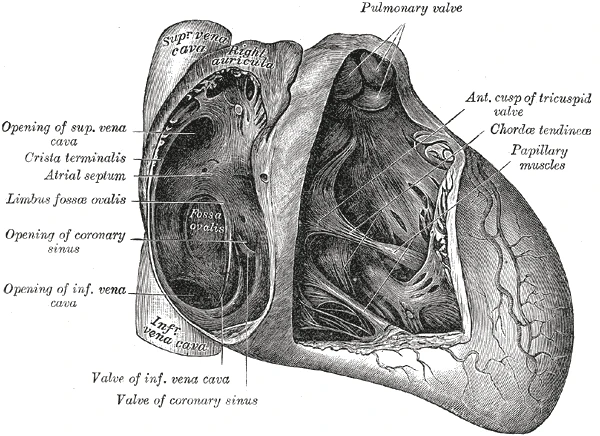 The right atrium and right ventricle opened: the fossa ovalis in the wall between the atria, and the papillary muscles and cords of the tricuspid valve, Gray's Anatomy, 1918, figure 493Wikimedia Commons, Henry Vandyke Carter, Public domain (Gray493.png)
In about a quarter of adults the flap never grows fully onto the septum, and a small opening remains. It stays closed as long as the pressure in the left atrium is the higher, and most people who have one never know.
Sources
- Arthur Guyton and John Hall, Textbook of Medical Physiology, 13th ed. (2016), ch. 84.
- Susan Standring (ed.), Gray's Anatomy, 42nd ed. (2020), chapters on the heart and on the development of the heart.
- Patrick Hagen, David Scholz and William Edwards, Incidence and size of patent foramen ovale during the first 10 decades of life, Mayo Clinic Proceedings 59 (1984): 17-20.
Prev: Before the first breathNext: Where blood is made