Four chambers
The heart is two pumps side by side, each with two chambers. Blood from the body enters the right atrium, passes to the right ventricle below it and is sent to the lungs. Back from the lungs it enters the left atrium, passes to the left ventricle and is sent to the body.
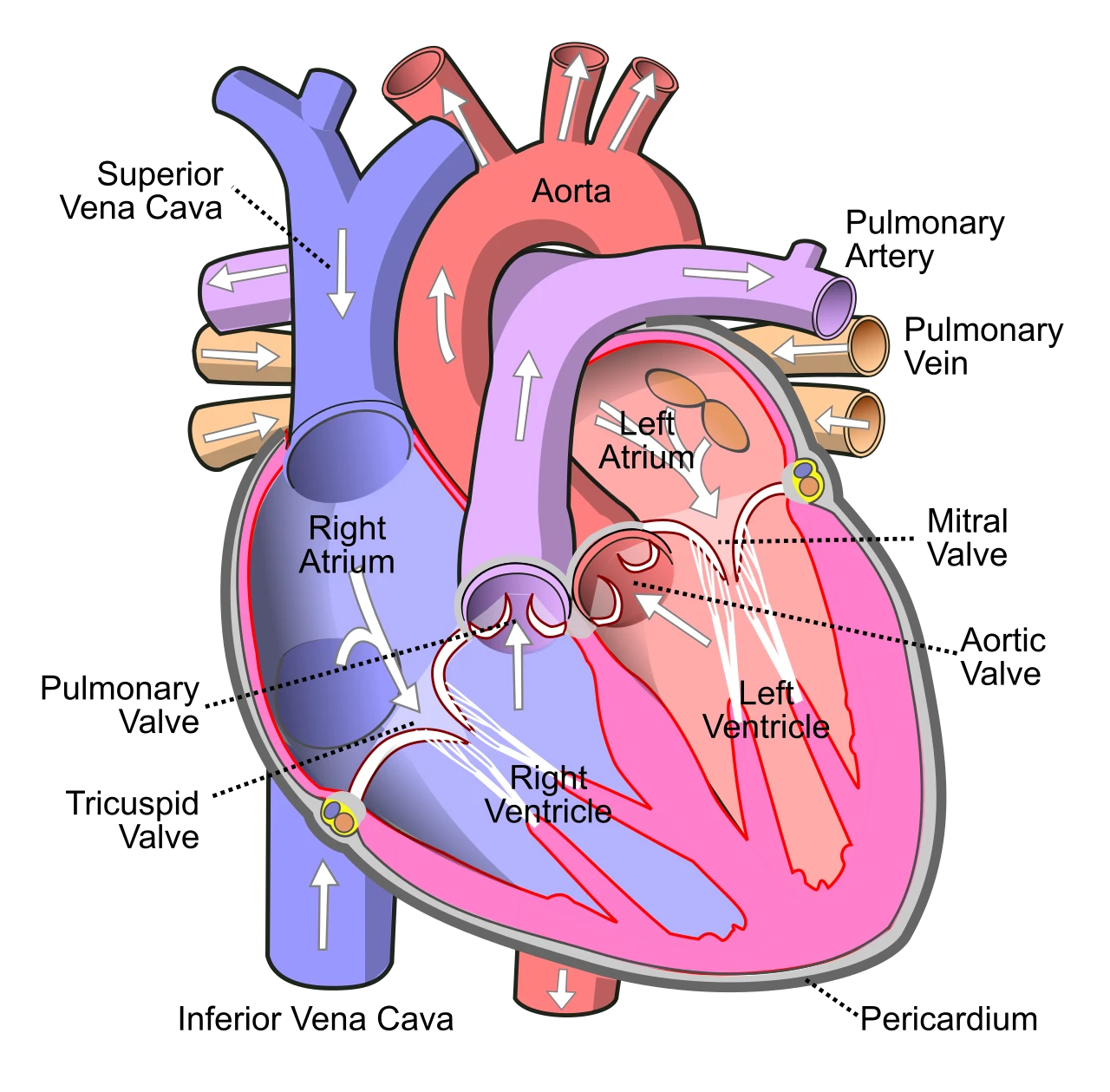 The four chambers and four valves of the heart and the great vessels, with arrows for the way the blood flowsWikimedia Commons, Wapcaplet, CC BY-SA 3.0 (Diagram of the human heart (cropped).svg)
The atria have thin walls, since they only push blood into the ventricles below them. The wall of the left ventricle is about three times as thick as that of the right, because it drives blood through the whole body while the right drives it only through the lungs.
A wall of muscle, the septum, divides the left side of the heart from the right. After birth no blood crosses it.
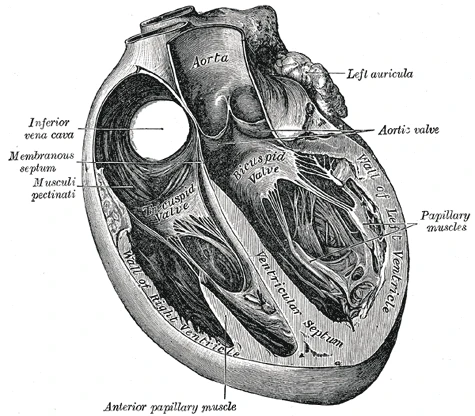 The heart opened: the chambers and valves, Gray's Anatomy, 1918, figure 498Wikimedia Commons, Henry Vandyke Carter, Public domain (Gray498.png)
Sources
- Susan Standring (ed.), Gray's Anatomy, 42nd ed. (2020), chapter on the heart.
- Arthur Guyton and John Hall, Textbook of Medical Physiology, 13th ed. (2016), ch. 9.
Prev: A body and its heartNext: The beat