2nd century
Galen
For some 1,400 years, medicine in Europe and the Islamic world followed Galen of Pergamon, a Greek physician who worked in Rome in the second century. He taught that the liver turned food into blood, and that the veins carried this blood out to the body, where it was used up as nourishment.
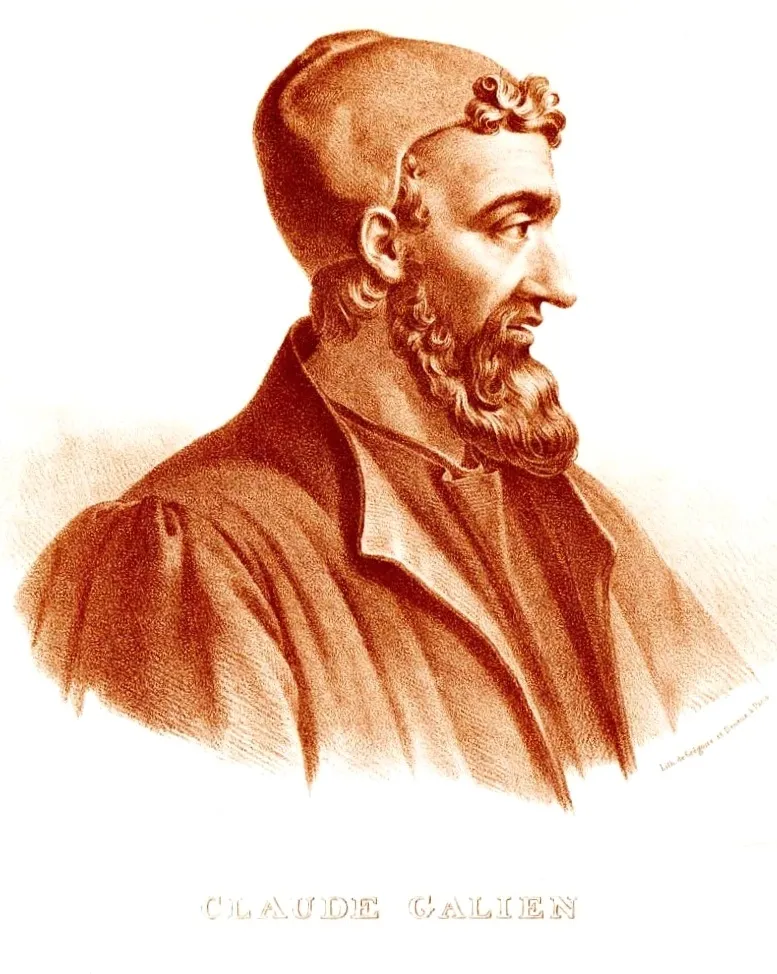 Galen of Pergamon, an imagined likeness, lithograph by Pierre-Roch Vigneron, 19th centuryWikimedia Commons, Pierre-Roch Vigneron, Public domain (Galen detail.jpg)
Some of the blood, he held, seeped from the right ventricle into the left through invisible pores in the wall between them. There it mixed with air from the lungs and left by the arteries as a warmer, brighter blood. Later anatomists found no such pores in the wall.
Galen did show that arteries carry blood. Earlier Greek anatomists had thought they carried air, since the arteries of a corpse are nearly empty. Galen tied off a stretch of artery in a living animal, opened it and found it full of blood.
Sources
- Galen, On the Usefulness of the Parts of the Body, trans. Margaret Tallmadge May (Ithaca: Cornell University Press, 1968).
- David Furley and J. S. Wilkie, Galen on Respiration and the Arteries (Princeton: Princeton University Press, 1984).
Prev: Where blood endsNext: Ibn al-Nafis