Air and blood
In the wall of each alveolus, blood and air are separated by less than a thousandth of a millimetre of tissue. Oxygen passes into the blood and carbon dioxide out. At rest a red cell spends about three quarters of a second in a lung capillary, and it is fully loaded within the first third of that time.
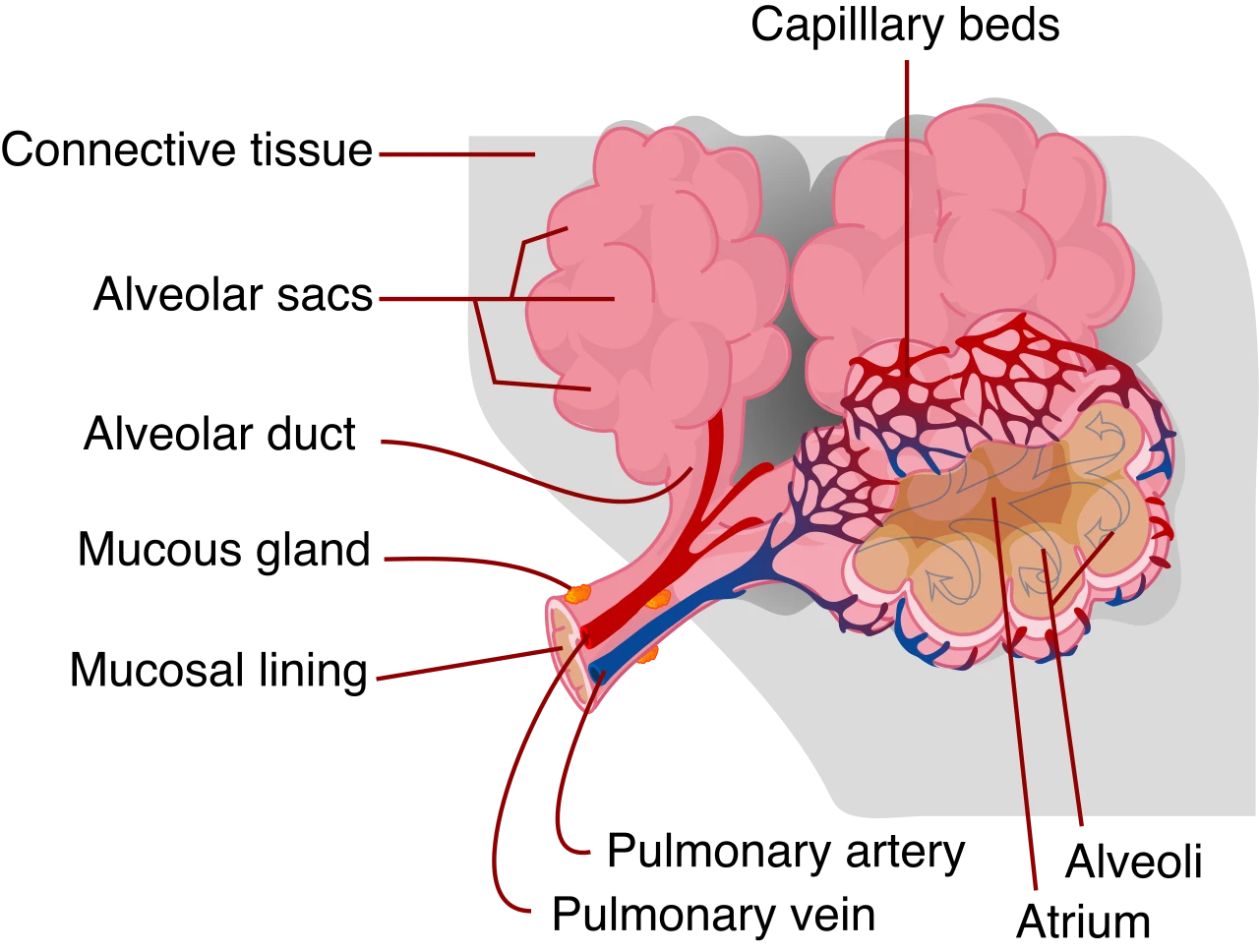 Alveoli at the end of an airway, wrapped in capillary beds that a branch of the pulmonary artery feeds and a branch of the pulmonary vein drainsWikimedia Commons, LadyofHats, Public domain (Alveolus diagram.svg)
The capillaries of the lungs hold only 60 to 140 millilitres of blood at any moment, spread over some 70 square metres in a film one red cell thick.
They drain into veins that run between the segments of the lung and join into the pulmonary veins, usually two from each lung. These carry the bright blood to the left atrium. In an adult they are the only veins that carry blood rich in oxygen.
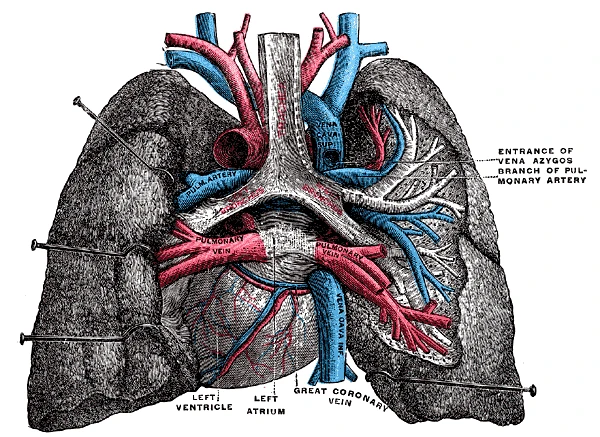 The heart and lungs from behind: the pulmonary arteries (blue) and veins (red) at the roots of the lungs, the veins opening into the left atrium, Gray's Anatomy, 1918, figure 504Wikimedia Commons, Henry Vandyke Carter, Public domain (Gray504.png)
Sources
- Arthur Guyton and John Hall, Textbook of Medical Physiology, 13th ed. (2016), ch. 40 and 41.
- Susan Standring (ed.), Gray's Anatomy, 42nd ed. (2020), chapter on the lungs.
Prev: Through the lungsNext: The aorta