Where blood is made
Blood is made inside bone. In a child every bone holds red marrow. In an adult it remains in the skull, the sternum and ribs, the vertebrae, the pelvis and the upper ends of the femurs, while the shafts of the long bones fill with yellow fat.
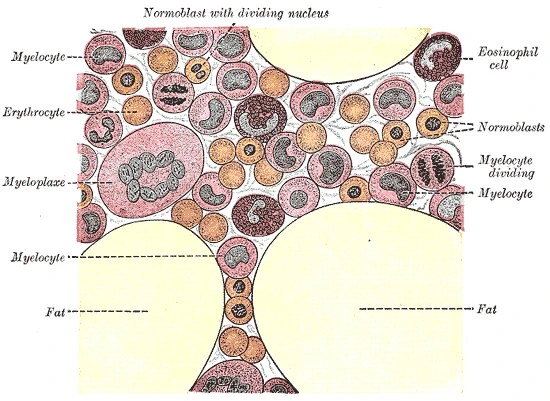 Red bone marrow, magnified: fat cells among the blood-forming cells, Gray's Anatomy, 1918, figure 72Wikimedia Commons, Henry Vandyke Carter, Public domain (Gray72.png)
The marrow makes some two million red cells a second, about 200 billion a day, together with the white cells and the platelets. A red cell matures in about a week, loses its nucleus, and slips into the blood as a disc about 8 micrometres across, packed with haemoglobin.
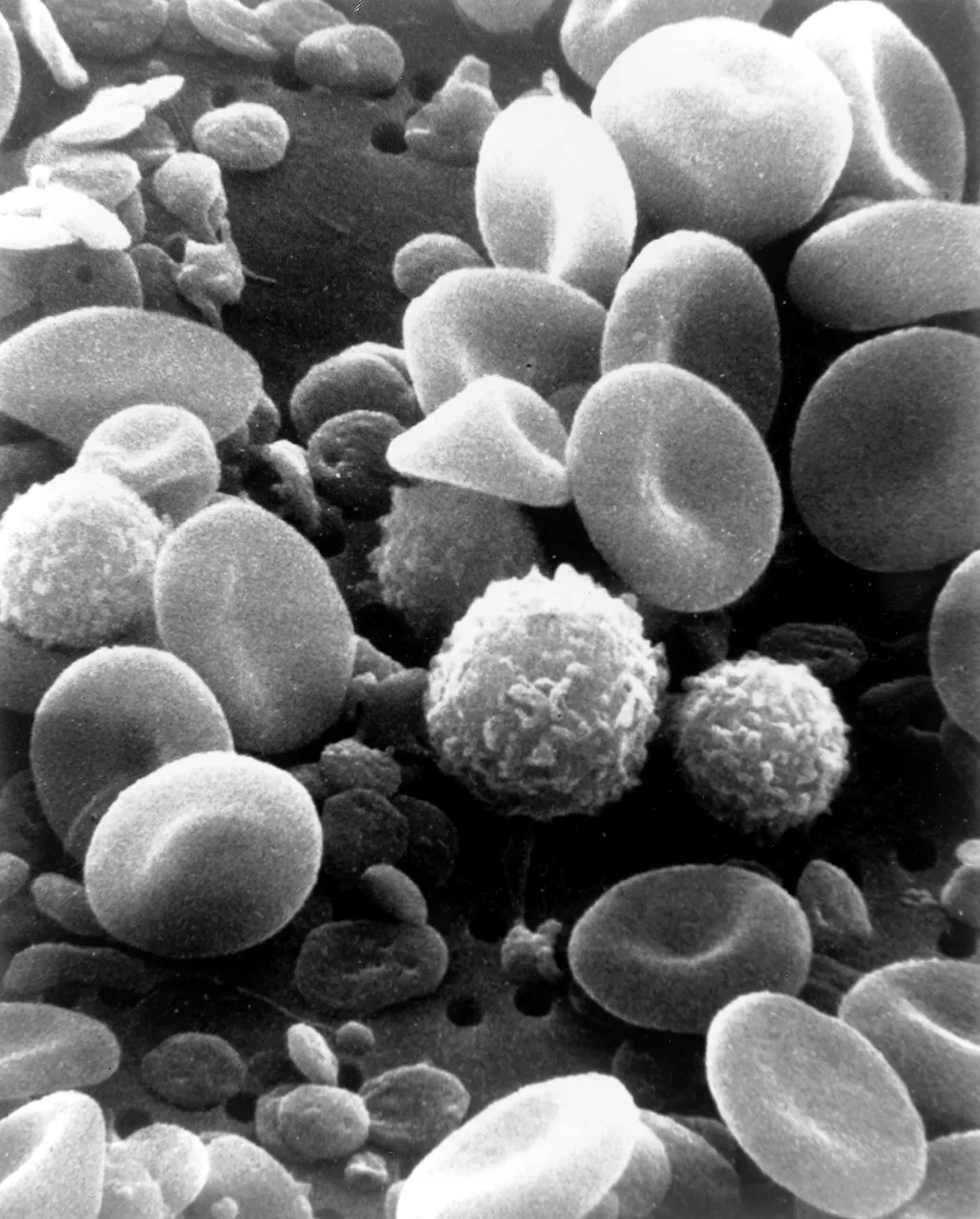 Red cells, white cells and platelets in circulating human blood, scanning electron micrographWikimedia Commons, Bruce Wetzel and Harry Schaefer, National Cancer Institute, Public domain (SEM blood cells.jpg)
The kidneys set the pace. When the blood reaching them carries too little oxygen, they release the hormone erythropoietin, and the marrow speeds up. This is why people who live at high altitude have more red cells in their blood.
Sources
- Arthur Guyton and John Hall, Textbook of Medical Physiology, 13th ed. (2016), ch. 33.
- Susan Standring (ed.), Gray's Anatomy, 42nd ed. (2020), ch. 4.
Prev: The first breathNext: Where blood ends