The muscle pump
At the end of the capillaries little of the heart's push is left, about 10 millimetres of mercury. Yet blood from the feet has to climb more than a metre to the heart. In the legs the deep veins, the posterior tibial, popliteal and femoral veins, lie between the muscles.
When the calf muscles contract, they squeeze these veins and push the blood upwards. Valves every few centimetres close behind it, so it cannot fall back when the muscles relax. Each step pumps the veins of the leg partly empty.
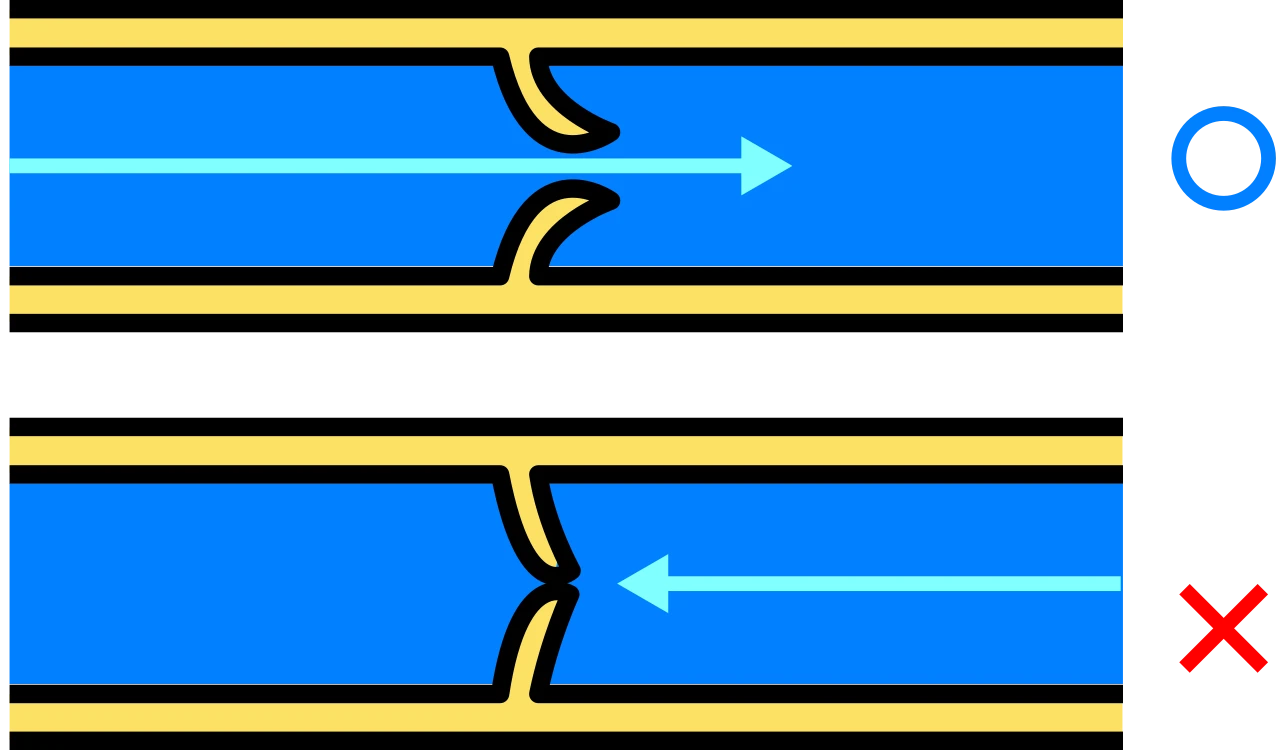 A valve in a vein: it opens to blood flowing towards the heart and closes against blood flowing backWikimedia Commons, Was a bee and ZooFari, Public domain (Venous valve.svg)
Standing still, the pressure in the veins of the feet rises to about 90 millimetres of mercury, the weight of the blood column up to the heart. Walking brings it below about 25. A soldier who stands at attention for long enough can faint, because blood pools in the legs and too little returns to the heart.
Sources
- Arthur Guyton and John Hall, Textbook of Medical Physiology, 13th ed. (2016), ch. 15 and 16.
- Susan Standring (ed.), Gray's Anatomy, 42nd ed. (2020), chapter on the leg.
Prev: Veins under the skinNext: The portal system