The portal system
Part of the venous blood takes a detour. The blood that leaves the gut, rich in what the meal contained, is gathered by the superior and inferior mesenteric veins and the splenic vein. Behind the pancreas they join into the portal vein, which carries the blood into the liver.
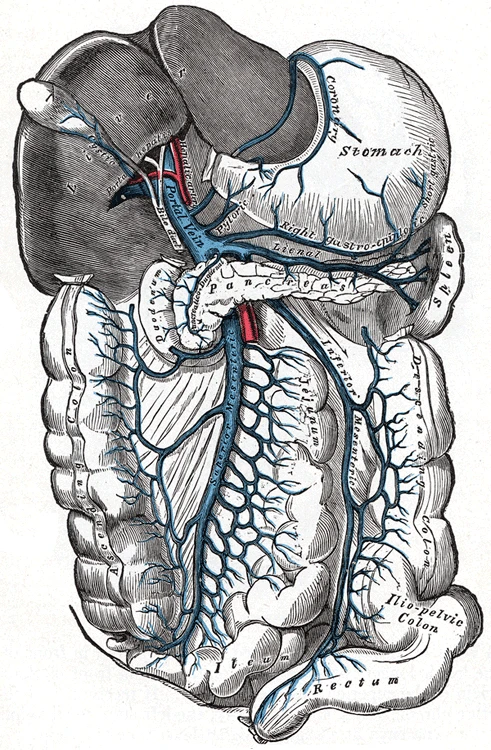 The portal vein and the veins that feed it from the stomach, intestines, pancreas and spleen, Gray's Anatomy, 1918, figure 591Wikimedia Commons, Henry Vandyke Carter, Public domain (Gray591.png)
In the liver this blood spreads through a second set of capillaries. Liver cells take up sugars and store or release them, make proteins, and break down drugs and poisons. Then the blood collects in the hepatic veins and joins the inferior vena cava just below the heart.
A vein that runs between two capillary beds is called a portal vein, and this is the largest. About three quarters of the liver's blood arrives this way, and a quarter by the hepatic artery.
Sources
- Susan Standring (ed.), Gray's Anatomy, 42nd ed. (2020), chapter on the liver.
- Arthur Guyton and John Hall, Textbook of Medical Physiology, 13th ed. (2016), ch. 71.
Prev: The muscle pumpNext: The whole circuit