Through the lungs
From the right ventricle the blood leaves by the pulmonary trunk. After about five centimetres it divides into the right and left pulmonary arteries, one for each lung. These are the only arteries in an adult that carry blood low in oxygen.
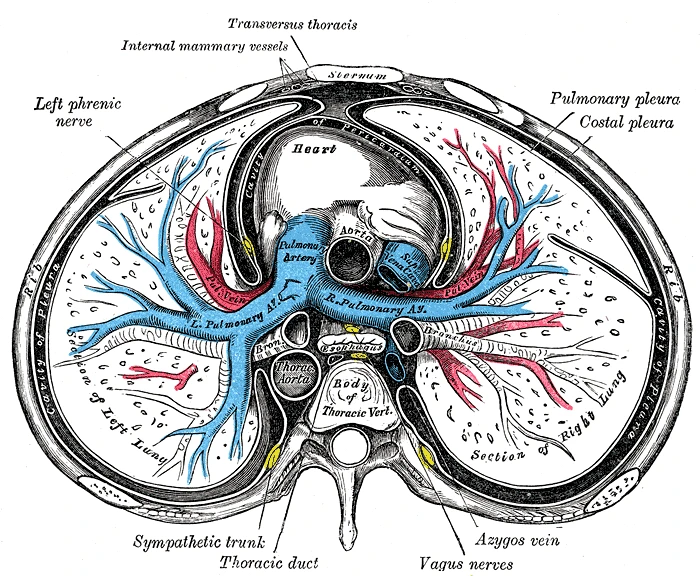 A cross-section of the chest seen from above: the pulmonary trunk dividing into the right and left pulmonary arteries, which branch into the lungs beside the bronchi, Gray's Anatomy, 1918, figure 503Wikimedia Commons, Henry Vandyke Carter, Public domain (Gray503.png)
Inside each lung the arteries branch alongside the airways, each bronchus with its artery, down to capillaries in the walls of some 300 million air sacs, the alveoli.
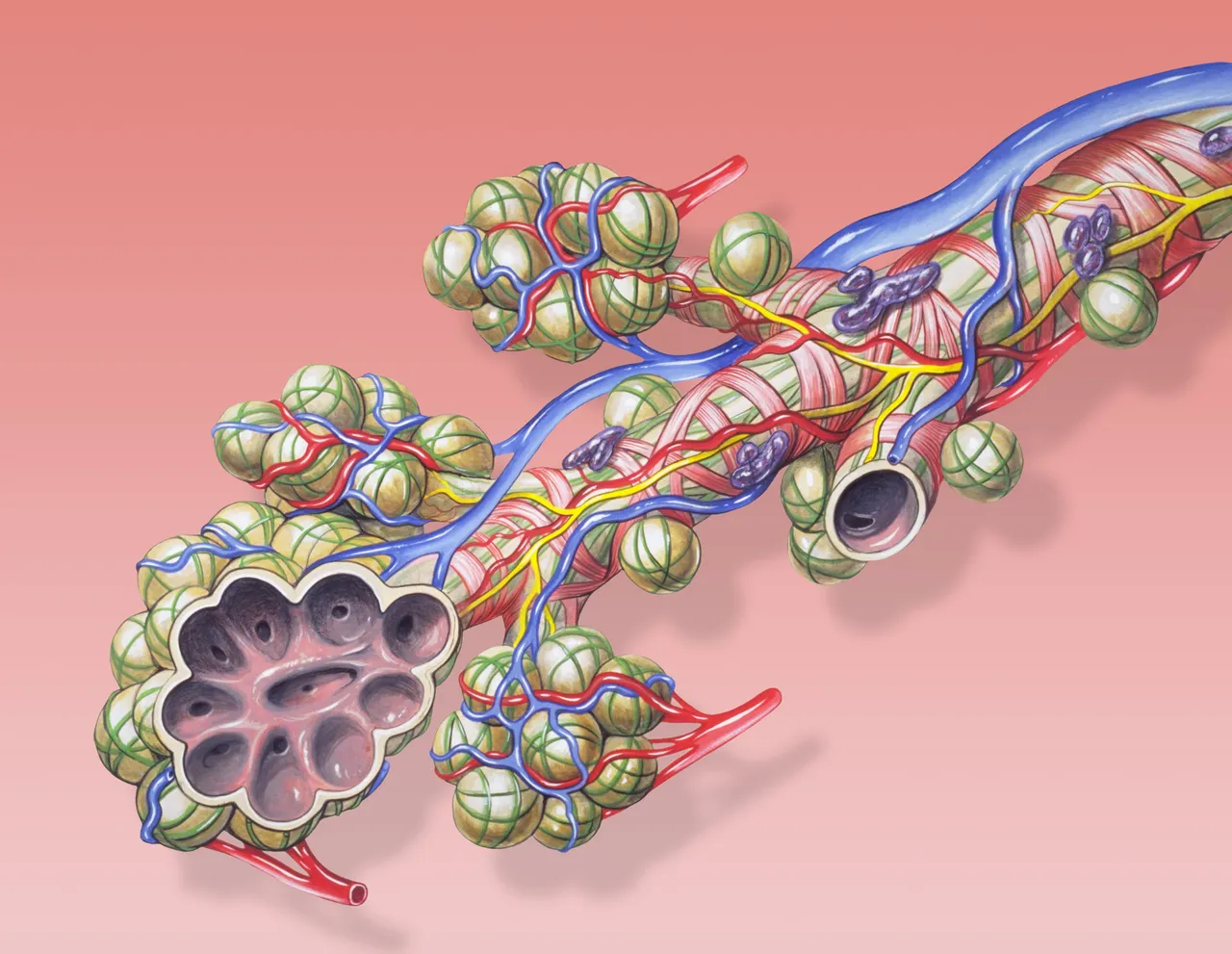 A small airway of the lung ending in air sacs, with its arteries and veins running beside it and around the sacsWikimedia Commons, Patrick J. Lynch, CC BY 2.5 (Bronchial anatomy.jpg)
The lungs lie close to the heart and their vessels are wide, so the right ventricle drives this loop with little pressure: about 25 millimetres of mercury at the peak of each beat, a fifth of what the left ventricle needs for the body.
Sources
- Arthur Guyton and John Hall, Textbook of Medical Physiology, 13th ed. (2016), ch. 39.
- Susan Standring (ed.), Gray's Anatomy, 42nd ed. (2020), chapters on the heart and the lungs.
Prev: The heart's veinsNext: Air and blood