The gut
Below the diaphragm the aorta sends three unpaired arteries to the gut. The first, the celiac trunk, is a stem about a centimetre long that splits into three: the left gastric artery to the stomach, the common hepatic to the liver and the splenic artery to the spleen.
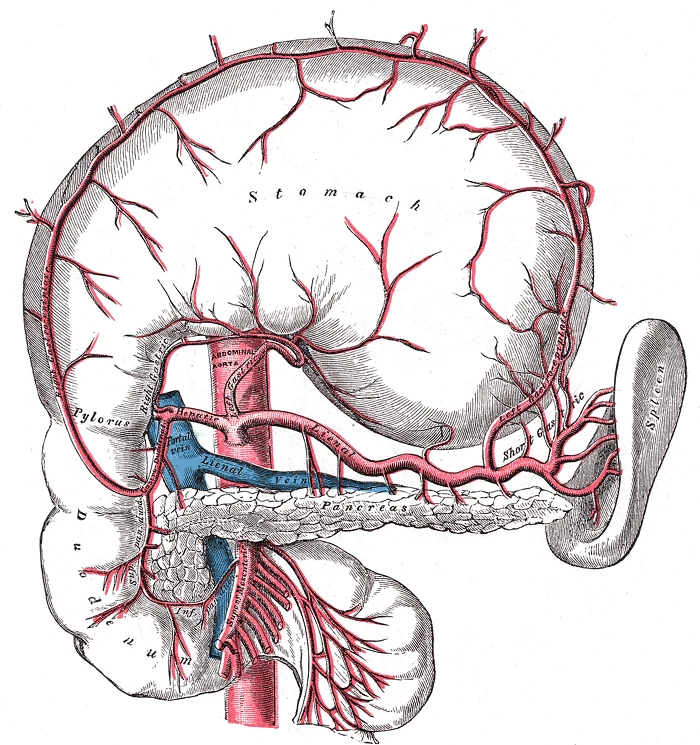 The celiac artery and its branches, the stomach raised, Gray's Anatomy, 1918, figure 533Wikimedia Commons, Henry Vandyke Carter, Public domain (Gray533.png)
The superior mesenteric artery feeds the whole small intestine and the large intestine as far as two thirds of the way along the transverse colon. The inferior mesenteric feeds the rest, down to the rectum.
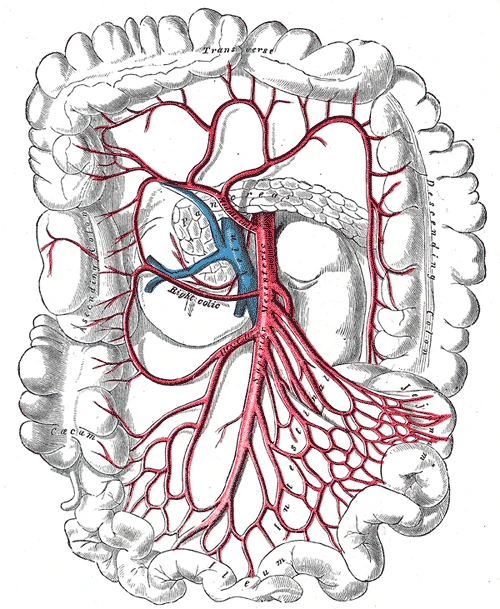 The superior mesenteric artery and the arches it forms in the mesentery, Gray's Anatomy, 1918, figure 534Wikimedia Commons, Henry Vandyke Carter, Public domain (Gray534.png)
At rest the gut, the liver, the pancreas and the spleen receive about a quarter of the heart's output. After a meal the arterioles of the gut widen, and the flow rises further while the food is absorbed.
Sources
- Susan Standring (ed.), Gray's Anatomy, 42nd ed. (2020), chapters on the stomach, the small intestine and the large intestine.
- Arthur Guyton and John Hall, Textbook of Medical Physiology, 13th ed. (2016), ch. 63.
Prev: Blood pressureNext: The kidneys