The beat
Each beat has two phases. In diastole the heart muscle relaxes. Blood from the veins fills the atria and runs on through the open tricuspid and mitral valves into the ventricles. Near the end the atria contract and add the last fifth or so of the filling. At rest diastole takes about three fifths of each beat.
In systole both ventricles contract together. The rising pressure shuts the valves behind them and opens those ahead. The left ventricle sends about 70 millilitres into the aorta, some 60 percent of what it held, and the right ventricle sends the same volume to the lungs.
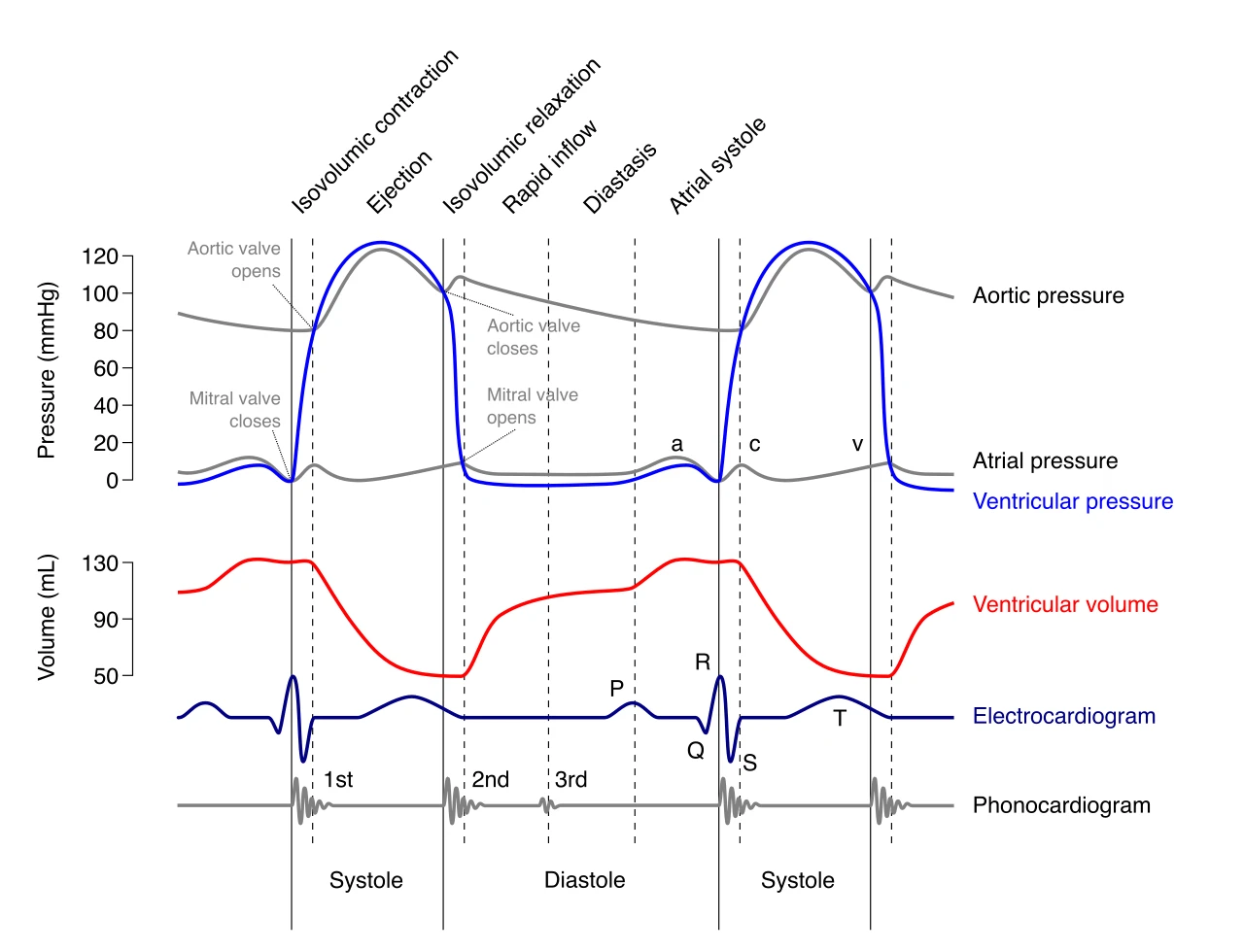 One beat of the left ventricle through systole and diastole: the pressures in the aorta, ventricle and atrium, the volume of the ventricle, the ECG and the heart soundsWikimedia Commons, DanielChangMD, DestinyQx and xavax, CC BY-SA 2.5 (Wiggers Diagram.svg)
The beat starts in the heart itself. A small patch of muscle in the wall of the right atrium, the sinoatrial node, fires about 70 times a minute at rest. The wave of contraction spreads over the atria, waits about a tenth of a second at the border with the ventricles, then runs through the ventricle walls.
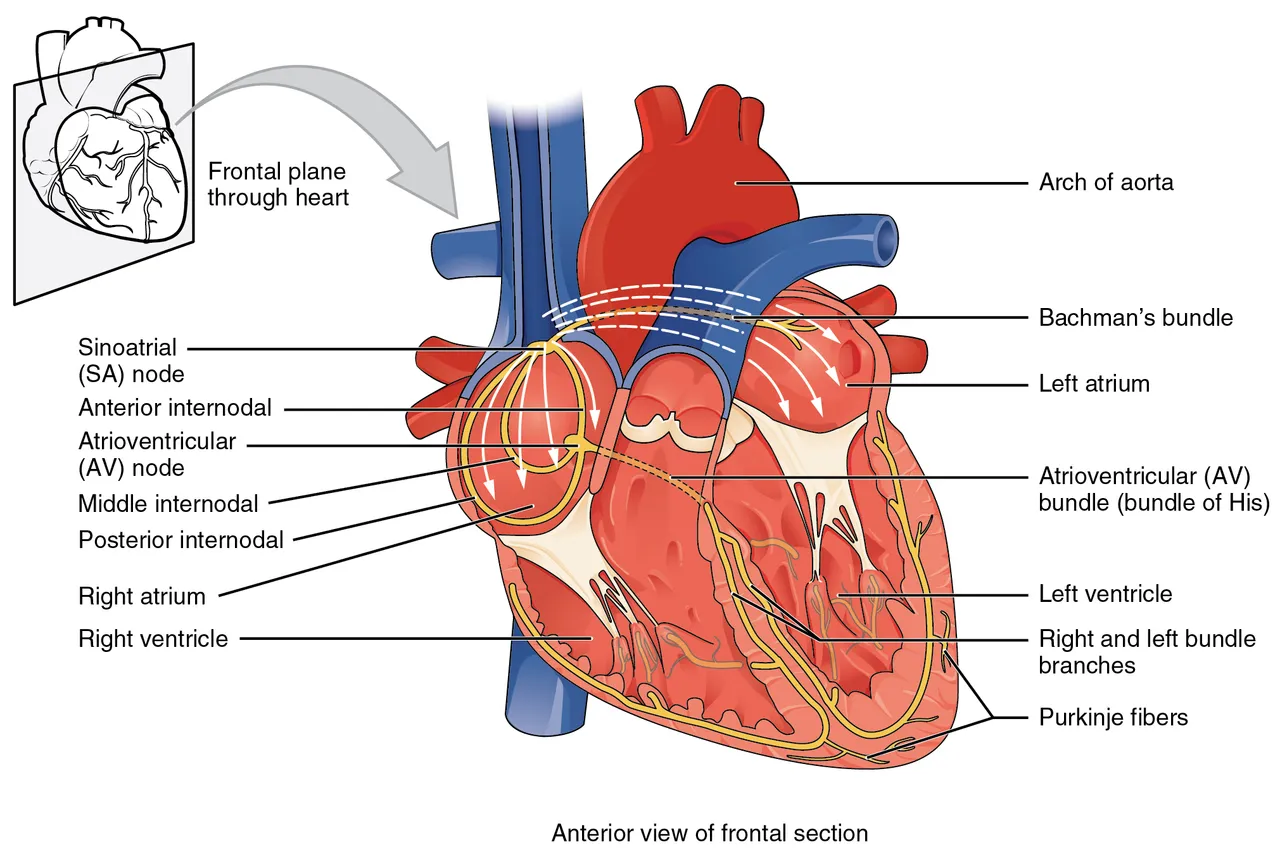 The conducting system of the heart: the sinoatrial node in the wall of the right atrium, the atrioventricular node and bundle, and the fibres that spread through the ventricle walls, OpenStax Anatomy and PhysiologyWikimedia Commons, OpenStax College, CC BY 3.0 (2018 Conduction System of Heart.jpg)
Sources
- Arthur Guyton and John Hall, Textbook of Medical Physiology, 13th ed. (2016), ch. 9 and 10.
- Susan Standring (ed.), Gray's Anatomy, 42nd ed. (2020), chapter on the heart.
Prev: Four chambersNext: The valves