The brain's arteries
The brain is about 2 percent of the body's weight and receives about 15 percent of its blood at rest. Four arteries bring it: the two internal carotids in front, and behind them the two vertebral arteries, which join under the brainstem into the basilar artery.
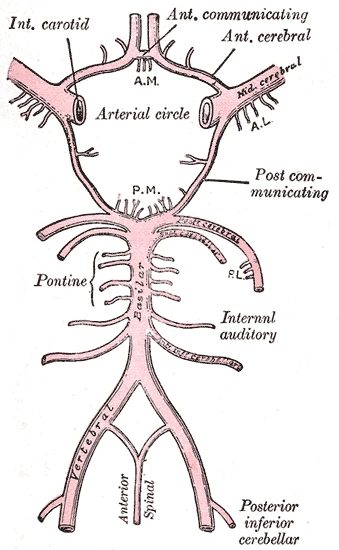 The arterial circle at the base of the brain, joining the two internal carotids and the basilar artery, Gray's Anatomy, 1918, figure 519Wikimedia Commons, Henry Vandyke Carter, Public domain (Gray519.png)
At the base of the brain these join in a ring, the arterial circle, described by Thomas Willis in 1664. From it the anterior, middle and posterior cerebral arteries spread over each hemisphere.
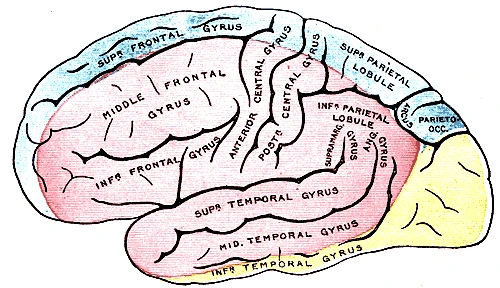 The outer surface of a cerebral hemisphere, coloured by the artery that feeds each area: anterior cerebral blue, middle cerebral pink, posterior cerebral yellow, Gray's Anatomy, 1918, figure 517Wikimedia Commons, Henry Vandyke Carter, Public domain (Gray517.png)
The ring can carry blood from one side to the other if an artery is blocked, but in many people one of its links is thin or missing. Brain cells store almost no oxygen. When the blood flow to the brain stops, consciousness is lost within about 5 to 10 seconds.
Sources
- Susan Standring (ed.), Gray's Anatomy, 42nd ed. (2020), chapter on the vascular supply of the brain.
- Arthur Guyton and John Hall, Textbook of Medical Physiology, 13th ed. (2016), ch. 62.
- Thomas Willis, Cerebri anatome (London, 1664).
Prev: Head and armsNext: The arm