The kidneys
The two renal arteries leave the aorta just below the superior mesenteric artery, short and wide. At each kidney they divide, and their branches fan out inside it until they reach about a million filters on each side, the glomeruli.
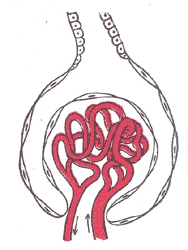 A glomerulus: a tuft of capillaries inside its capsule, with the vessel that brings the blood and the one that takes it away, Gray's Anatomy, 1918, figure 1130Wikimedia Commons, Henry Vandyke Carter, Public domain (Gray1130.png)
The kidneys weigh about 300 grams together and receive about a fifth of the heart's output, some 1.1 litres a minute. Their work is to filter the blood: about 180 litres of fluid a day pass into the tubules, and all but about a litre and a half is taken back.
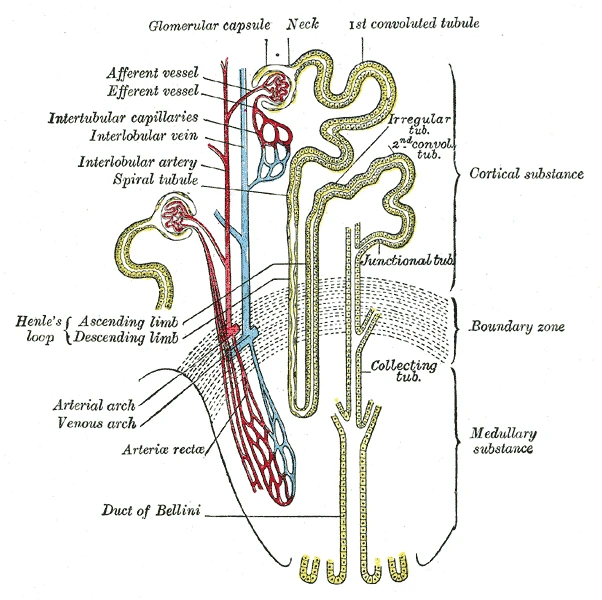 A nephron with its blood vessels: an afferent vessel enters each glomerulus in its capsule, and an efferent vessel leaves it to feed the capillaries around the tubules, Gray's Anatomy, 1918, figure 1128Wikimedia Commons, Henry Vandyke Carter, Public domain (Gray1128.png)
The blood gathers in the veins of the kidney and leaves by the renal veins into the inferior vena cava. The left renal vein is the longer, since the vena cava lies to the right of the midline, and it crosses in front of the aorta just below the superior mesenteric artery.
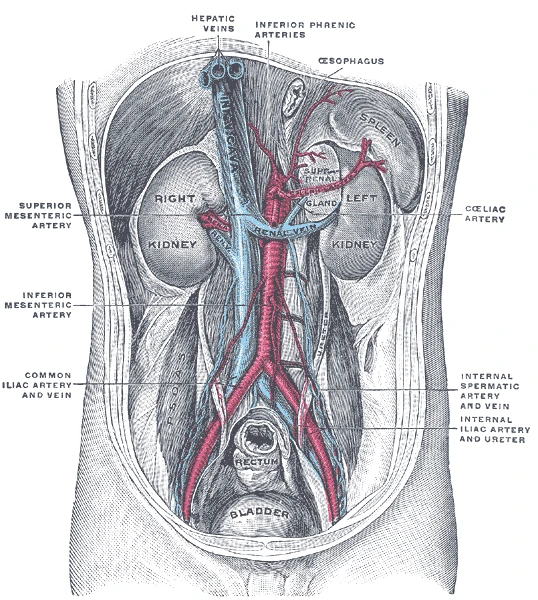 The kidneys and their vessels: the renal arteries leave the aorta, and the left renal vein crosses in front of the aorta to the inferior vena cava, Gray's Anatomy, 1918, figure 1121Wikimedia Commons, Henry Vandyke Carter, Public domain (Gray1121.png)
Sources
- Susan Standring (ed.), Gray's Anatomy, 42nd ed. (2020), chapter on the kidney and ureter.
- Arthur Guyton and John Hall, Textbook of Medical Physiology, 13th ed. (2016), ch. 26 and 27.
Prev: The gutNext: The thigh