A meal's journey
A bite is chewed for a few seconds and swallowed in one, and the digestive tract takes over. It reaches the stomach about ten seconds later. The stomach churns it and over about four hours passes nearly all of it on. The small intestine takes another three to five hours and absorbs nearly everything the body can use.
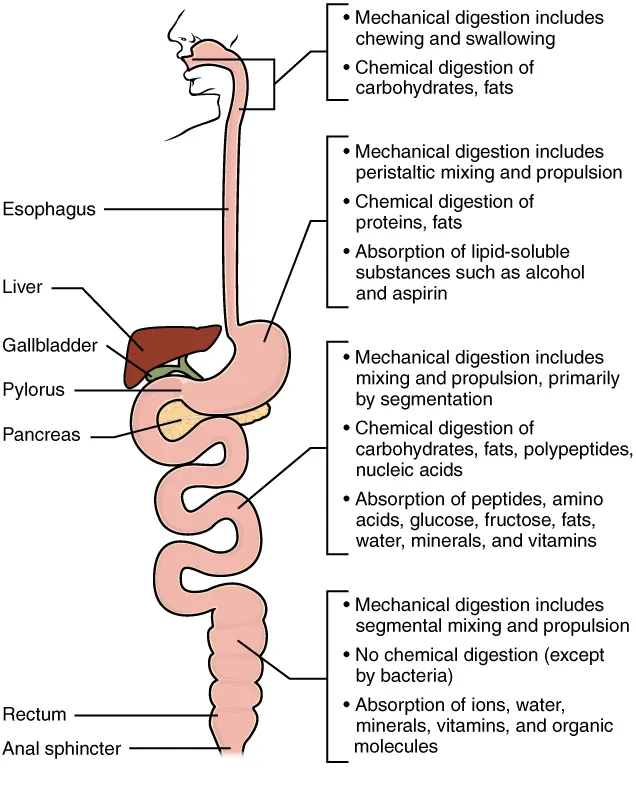 What each part of the tract does: mechanical digestion, chemical digestion and absorption, OpenStax Anatomy and PhysiologyWikimedia Commons, OpenStax College, CC BY 3.0 (2426 Mechanical and Chemical DigestionN.jpg)
The slowest part is the colon. In healthy adults its contents take on average about a day and a half to pass, and up to three days is normal. The remains of a meal leave the body a day or two after it was eaten, mixed with the remains of several others.
Sources
- Arthur Guyton and John Hall, Textbook of Medical Physiology, 13th ed. (2016), ch. 64.
- Thomas Abell and others, Consensus recommendations for gastric emptying scintigraphy, American Journal of Gastroenterology 103 (2008): 753 to 763.
- Arnold Metcalf and others, Simplified assessment of segmental colonic transit, Gastroenterology 92 (1987): 40 to 47.
Prev: Blood from the gutNext: A window into the stomach