Acid and pepsin
The lining of the stomach is pitted with millions of tubular glands. In the body and the fundus, parietal cells in these glands pump out hydrochloric acid at a pH of about 0.8, some three million times more acid than blood. Chief cells release pepsinogen, which the acid turns into pepsin, an enzyme that cuts proteins into shorter chains.
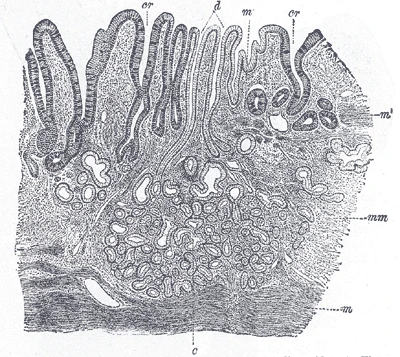 Section of the stomach lining near its entrance, with its glands, Gray's Anatomy, 1918, figure 1053Wikimedia Commons, Henry Vandyke Carter, Public domain (Gray1053.png)
The acid also kills most of the bacteria that arrive with food. The stomach makes about 1.5 litres of gastric juice a day. The parietal cells add intrinsic factor, a protein the ileum needs to absorb vitamin B12.
The stomach protects itself with a layer of alkaline mucus more than a millimetre thick, and its surface cells are replaced every few days. In the 1980s Barry Marshall and Robin Warren showed that most ulcers follow infection by a bacterium, Helicobacter pylori. They received the Nobel Prize in 2005.
Sources
- Arthur Guyton and John Hall, Textbook of Medical Physiology, 13th ed. (2016), ch. 65.
- Susan Standring (ed.), Gray's Anatomy, 42nd ed. (2020), chapter on the abdominal oesophagus and stomach.
- Barry Marshall and Robin Warren, Unidentified curved bacilli in the stomach of patients with gastritis and peptic ulceration, The Lancet 323 (1984): 1311 to 1315.
Prev: A bag of muscleNext: Chyme and the pylorus