Chyme and the pylorus
Every 15 to 20 seconds a wave of contraction sweeps along the stomach towards the pylorus. The antrum squeezes the food against the nearly closed outlet and throws most of it back, again and again. Mixed with acid and enzymes, the meal becomes chyme, a thick milky fluid.
The pylorus is a thick ring of muscle. It lets water out freely but holds back pieces larger than a millimetre or two, and each strong wave sends a few millilitres of chyme into the duodenum. Within about four hours a healthy stomach has emptied more than nine tenths of a solid meal.
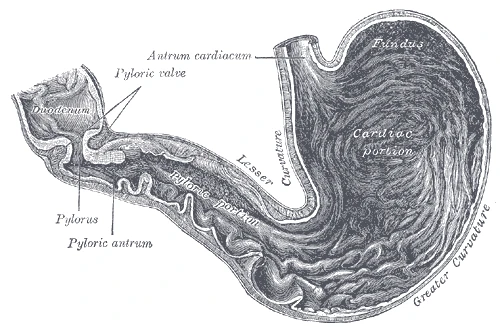 Interior of the stomach, with the pylorus and its valve at the outlet into the duodenum, Gray's Anatomy, 1918, figure 1050Wikimedia Commons, Henry Vandyke Carter, Public domain (Gray1050.png)
The duodenum sets the pace. Acid, fat and stretch in its wall slow the stomach through nerves and through hormones such as cholecystokinin, so a fatty meal stays longer.
Sources
- Arthur Guyton and John Hall, Textbook of Medical Physiology, 13th ed. (2016), ch. 64.
- Thomas Abell and others, Consensus recommendations for gastric emptying scintigraphy, American Journal of Gastroenterology 103 (2008): 753 to 763.
Prev: Acid and pepsinNext: Where the ducts open