The esophagus
The esophagus is a muscular tube about 25 cm long. It runs down the neck behind the trachea, through the chest behind the heart and beside the aorta, and through the diaphragm into the stomach. Between swallows it lies flat and empty. Its upper third is skeletal muscle like that of the limbs, the rest smooth muscle like the gut's.
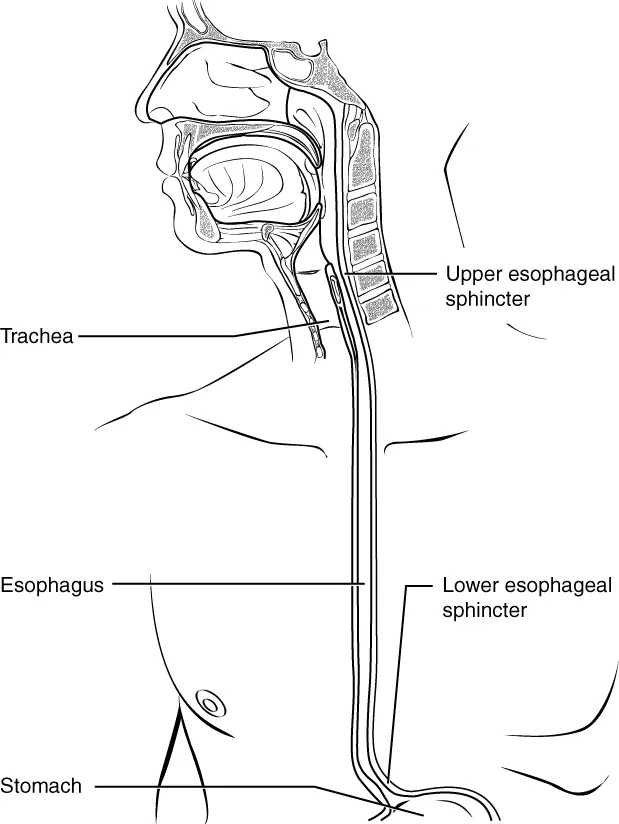 The esophagus from the pharynx to the stomach, with its upper and lower sphincters, OpenStax Anatomy and PhysiologyWikimedia Commons, OpenStax College, CC BY 3.0 (2412 The Esophagus.jpg)
A swallow starts a ring of contraction that travels down the tube and drives the bolus ahead of it, a movement called peristalsis. The wave takes 8 to 10 seconds to reach the stomach, a little less when gravity helps. The muscle does the work, so a person can swallow upside down and astronauts can eat in orbit.
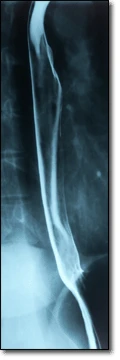 X-ray of the esophagus outlined by swallowed bariumWikimedia Commons, Glitzy queen00, Public domain (Barium swallow.png)
Sources
- Susan Standring (ed.), Gray's Anatomy, 42nd ed. (2020), chapter on the abdominal oesophagus and stomach.
- Arthur Guyton and John Hall, Textbook of Medical Physiology, 13th ed. (2016), ch. 64.
Prev: The throatNext: Through the diaphragm