Bile and the gallbladder
The liver makes 600 to 1,000 ml of bile a day, which drains down its bile ducts. Between meals their outlet is closed, so bile backs up the cystic duct into the gallbladder, a pear-shaped bag under the liver that holds 30 to 60 ml. Its lining absorbs water and salt and concentrates the bile about five times.
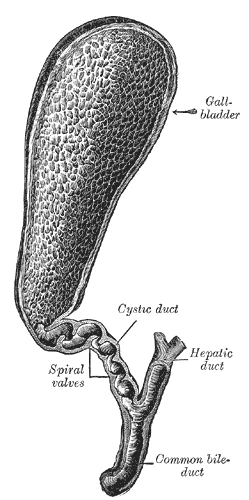 The gallbladder and bile ducts laid open: the cystic duct with its spiral folds, the hepatic duct and the common bile duct, Gray's Anatomy, 1918, figure 1095Wikimedia Commons, Henry Vandyke Carter, Public domain (Gray1095-gall bladder.png)
When fat reaches the duodenum, the hormone cholecystokinin makes the gallbladder contract and the outlet relax, and bile flows down the bile duct into the duodenum. Bile salts break fat into fine droplets that lipase can reach, then carry the products to the gut wall. Most bile salts are absorbed again in the ileum and used many times over.
When bile holds more cholesterol than its salts can keep dissolved, crystals form and grow into gallstones. Many people carry stones without knowing it. A stone that blocks a duct causes sharp pain under the right ribs.
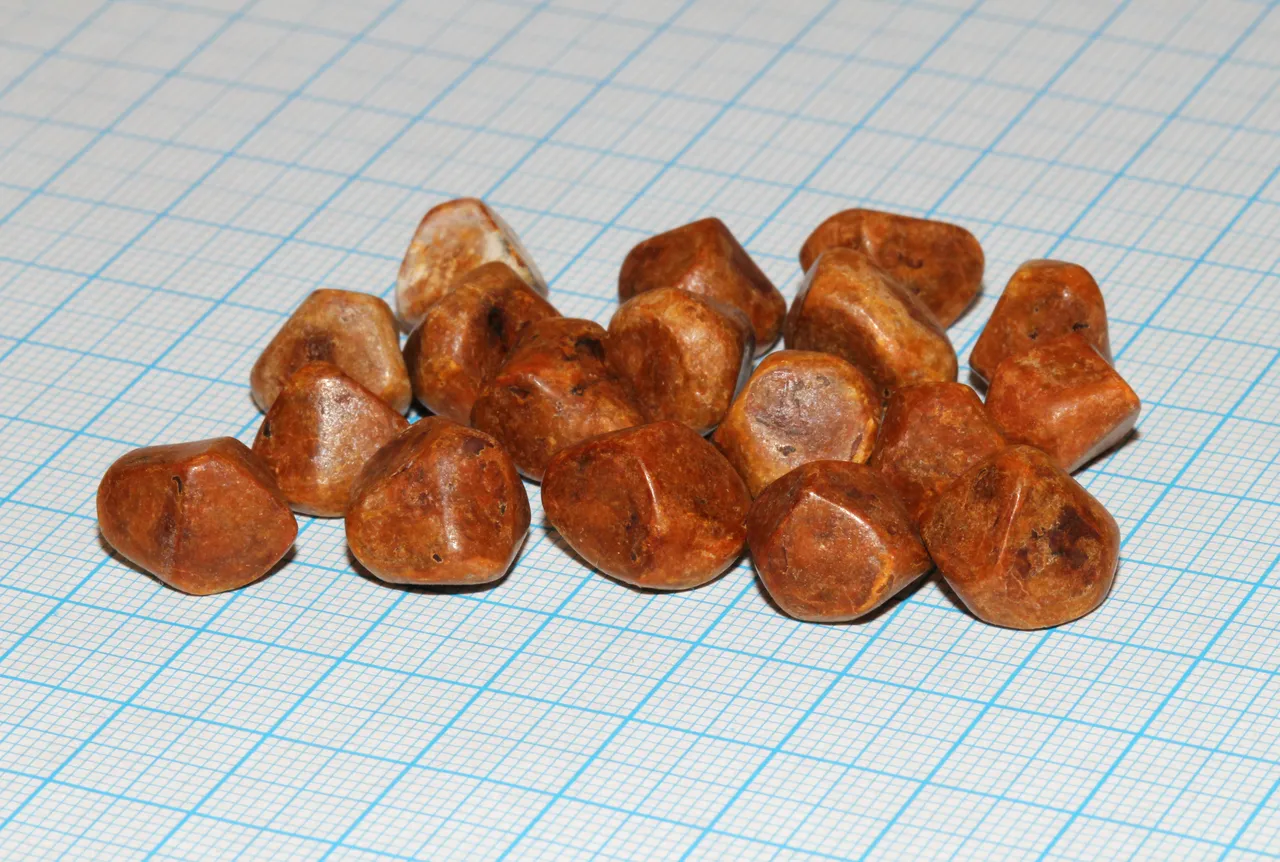 Gallstones removed from one patient, on a millimetre gridWikimedia Commons, George Chernilevsky, CC BY-SA 4.0 (Human gallstones 2015 G1.jpg)
Sources
- Susan Standring (ed.), Gray's Anatomy, 42nd ed. (2020), chapter on the gallbladder and biliary tree.
- Arthur Guyton and John Hall, Textbook of Medical Physiology, 13th ed. (2016), ch. 65 and 71.
Prev: The pancreasNext: Six metres of gut