The mesentery
The jejunum and ileum hang from the back wall of the abdomen on the mesentery, a fan-shaped double sheet of peritoneum with fat between its layers. Its root on the back wall is only about 15 cm long, but its free edge carries the whole six metres of coiled gut, which lets the loops move as they work.
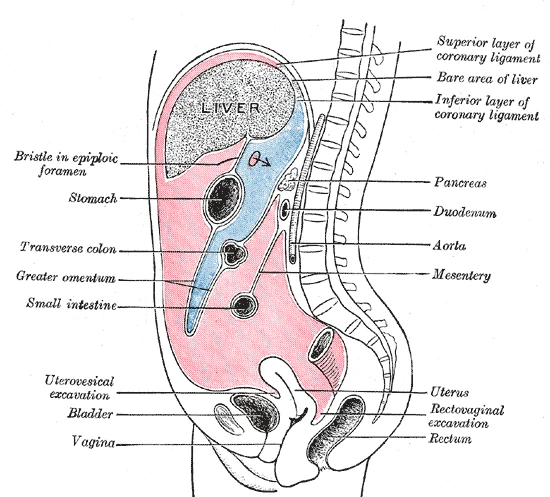 The abdomen cut down the middle, showing the peritoneum and the mesentery that holds the small intestine, Gray's Anatomy, 1918, figure 1035Wikimedia Commons, Henry Vandyke Carter, Public domain (Gray1035.png)
Between the two layers run the vessels, lymph nodes and nerves of the gut. The superior mesenteric artery branches into arches that feed every loop. The blood that leaves, carrying the absorbed sugars and amino acids, gathers in the superior mesenteric vein and flows on to the liver.
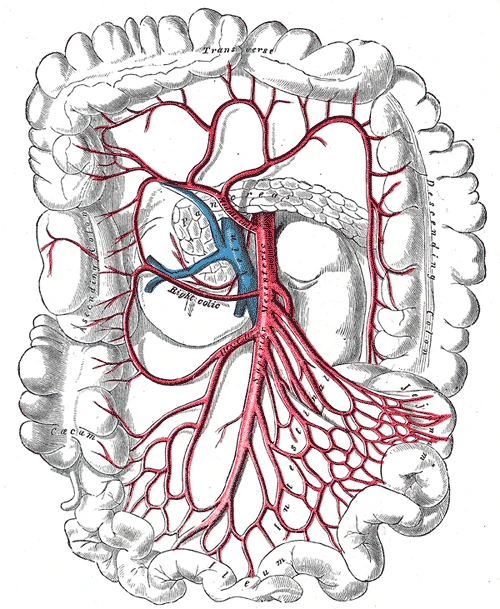 The superior mesenteric artery and the arches it forms in the mesentery, Gray's Anatomy, 1918, figure 534Wikimedia Commons, Henry Vandyke Carter, Public domain (Gray534.png)
In 2016 the surgeons Calvin Coffey and Peter O'Leary showed that the mesentery is one continuous structure from the duodenum to the rectum, and proposed that it be counted as an organ.
Sources
- Susan Standring (ed.), Gray's Anatomy, 42nd ed. (2020), chapter on the peritoneum, mesentery and peritoneal cavity.
- Arthur Guyton and John Hall, Textbook of Medical Physiology, 13th ed. (2016), ch. 63.
- Calvin Coffey and Peter O'Leary, The mesentery: structure, function, and role in disease, The Lancet Gastroenterology and Hepatology 1 (2016): 238 to 247.
Prev: Folds and villiNext: The colon