The pancreas
The pancreas is a soft gland 12 to 15 cm long lying across the back of the abdomen behind the stomach. Its head sits in the curve of the duodenum and its tail against the spleen. Clusters of cells along its branching ducts make about a litre of juice a day, and the pancreatic duct carries it to the duodenum.
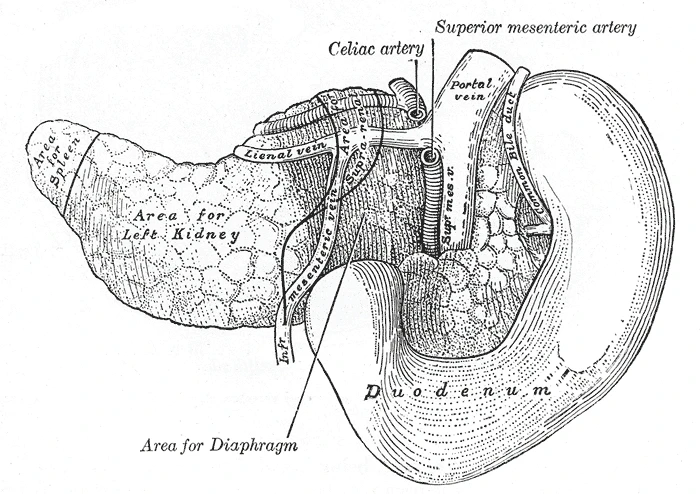 The pancreas and duodenum from behind, the tail of the pancreas reaching the spleen, Gray's Anatomy, 1918, figure 1099Wikimedia Commons, Henry Vandyke Carter, Public domain (Gray1099.png)
The juice holds enzymes for every main food: trypsin and chymotrypsin for proteins, amylase for starch and lipase for fat. The protein enzymes leave the pancreas inactive and are switched on only in the duodenum. When they switch on inside the gland, it starts to digest itself, which is acute pancreatitis.
Scattered through the gland are 1 to 2 million islets of Langerhans. They make up one or two percent of its mass and send insulin and glucagon into the blood.
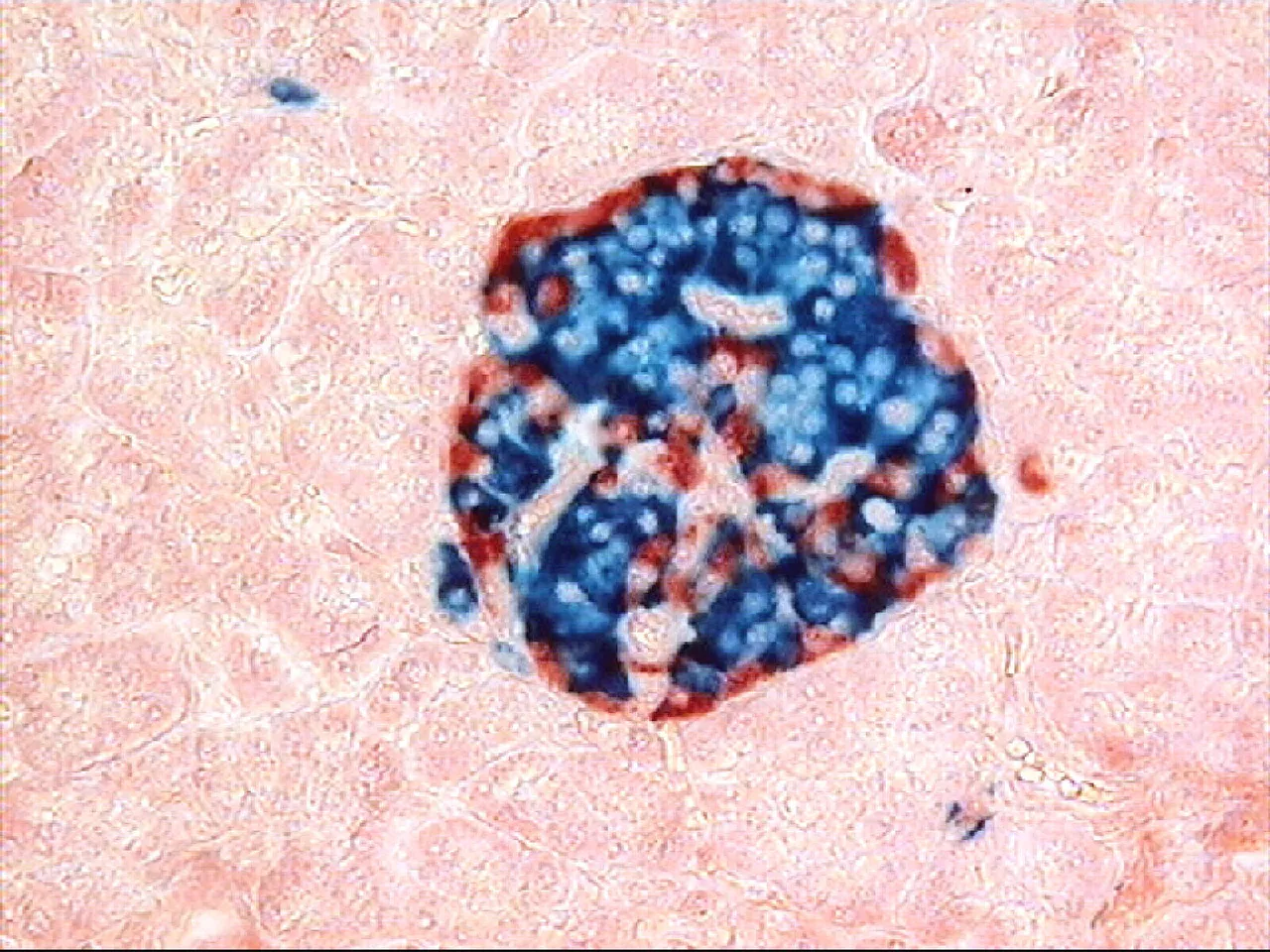 An islet of Langerhans in the human pancreas, stained for insulin (blue) and glucagon (red)Wikimedia Commons, Afferent, CC BY-SA 3.0 (Human pancreatic islet.jpg)
Sources
- Susan Standring (ed.), Gray's Anatomy, 42nd ed. (2020), chapter on the pancreas.
- Arthur Guyton and John Hall, Textbook of Medical Physiology, 13th ed. (2016), ch. 65 and 79.
Prev: Where the ducts openNext: Bile and the gallbladder