1904
Pavlov's dogs
In St Petersburg in the 1890s Ivan Pavlov operated on dogs so that their digestive glands opened to the skin, and kept them healthy for years. In his best-known experiment the esophagus was divided in the neck and both ends brought out. Food the dog ate fell out before reaching the stomach, yet the stomach poured out juice within minutes.
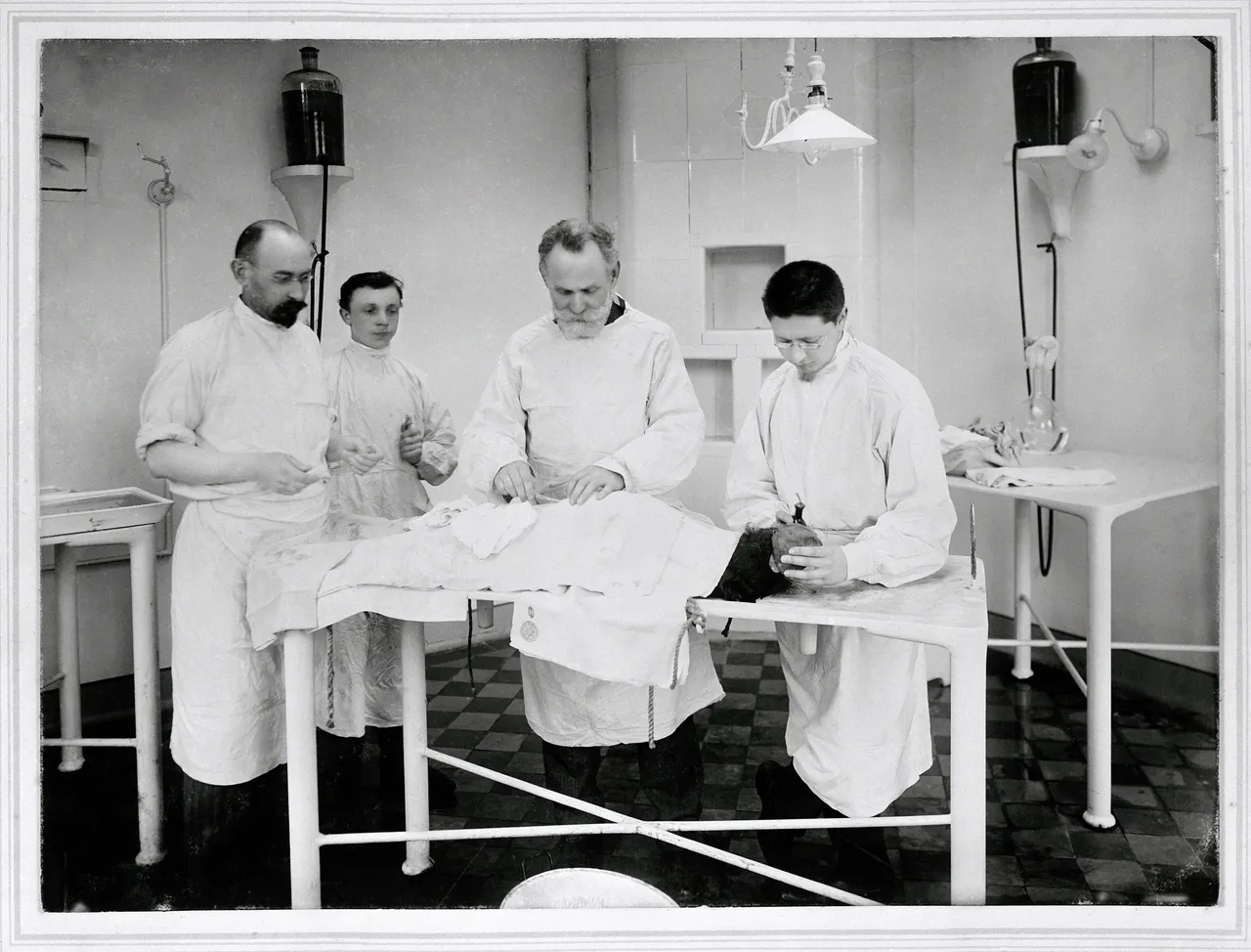 Ivan Pavlov, third from left, and colleagues operating on a dog at the Imperial Institute of Experimental Medicine, St PetersburgWikimedia Commons, Wellcome Collection, CC BY 4.0 (I.P. Pavlov with three colleagues operating on a dog in the Wellcome L0022534.jpg)
When he cut the vagus nerves, the juice stopped. The sight, smell and taste of food start gastric secretion through the brain, a phase now known to give about 30 percent of the juice a meal produces. His laboratory sold the juice from these dogs as a remedy for indigestion.
In 1904 Pavlov received the Nobel Prize for his work on the physiology of digestion. His dogs also began to drip saliva from their salivary glands at signals that came before food, and he spent his later decades on these conditioned reflexes.
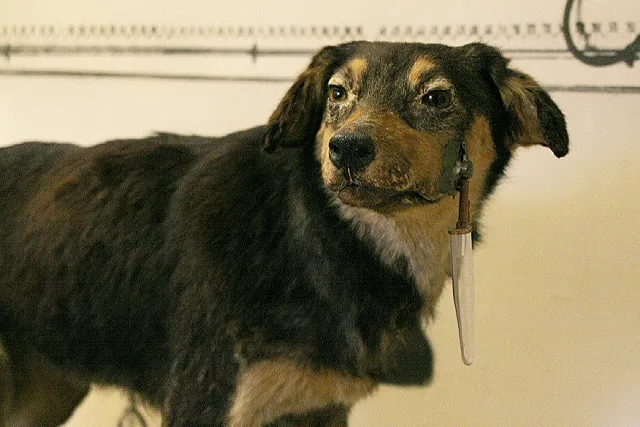 One of Pavlov's dogs, preserved at the Pavlov Museum in Ryazan, with the tube and container that collected its salivaWikimedia Commons, Rklawton, CC BY-SA 3.0 (One of Pavlov's dogs.jpg)
Sources
- Ivan Pavlov, The Work of the Digestive Glands, translated by W. H. Thompson (London: Charles Griffin, 1902).
- Ivan Pavlov, Physiology of digestion, Nobel lecture, 12 December 1904.
- Daniel Todes, Pavlov's Physiology Factory (Baltimore: Johns Hopkins University Press, 2002).
- Arthur Guyton and John Hall, Textbook of Medical Physiology, 13th ed. (2016), ch. 65.
Prev: A window into the stomach