Blood from the gut
All the blood that leaves the stomach, intestines, pancreas and spleen passes through the liver before it reaches the heart. The superior mesenteric vein and the splenic vein join behind the pancreas to form the portal vein, which carries about a litre a minute into the liver. The hepatic artery adds some 300 ml a minute, rich in oxygen.
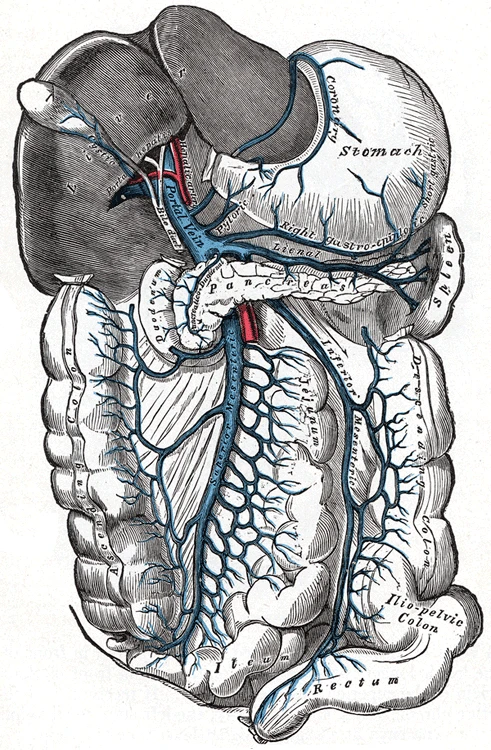 The portal vein and the veins that feed it from the stomach, intestines, pancreas and spleen, Gray's Anatomy, 1918, figure 591Wikimedia Commons, Henry Vandyke Carter, Public domain (Gray591.png)
Inside the liver the blood seeps through wide capillaries past rows of liver cells. The cells store glucose as glycogen and release it between meals, make albumin and clotting proteins, turn ammonia into urea and break down alcohol and many drugs. The blood then gathers in the hepatic veins and enters the inferior vena cava.
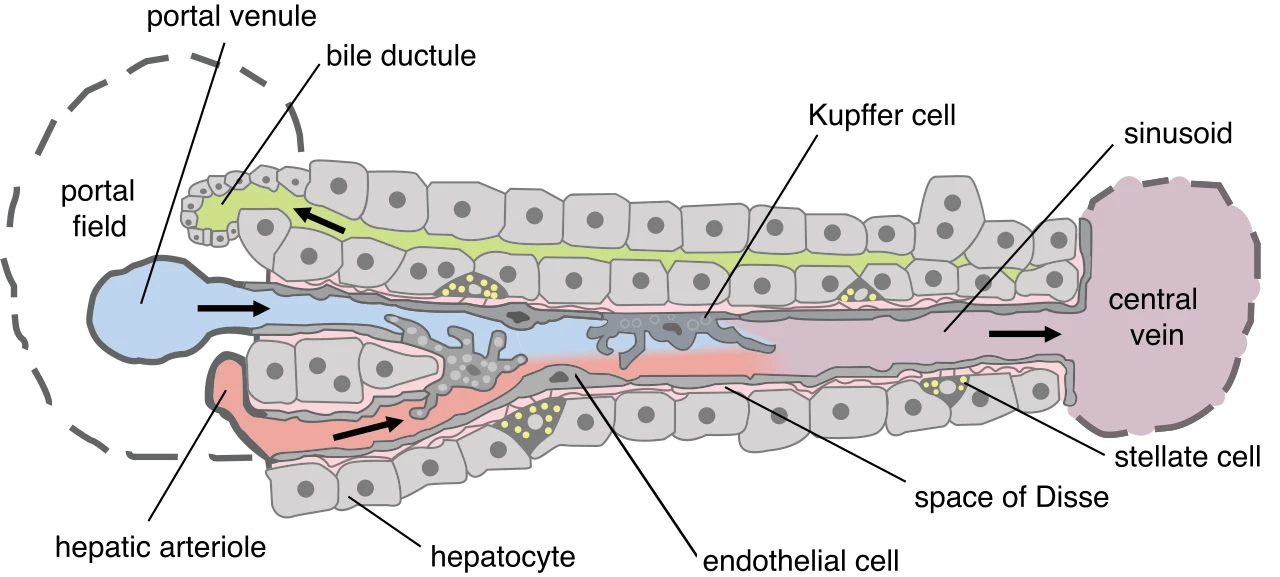 Blood from a portal venule and a hepatic arteriole flowing along a sinusoid past liver cells to the central veinWikimedia Commons, Frevert U and others, SVG by Viacheslav Vtyurin, CC BY 2.5 (Hepatic structure2.svg)
The liver also keeps stores: enough vitamin B12 for a year or more, enough vitamin A for about ten months, and iron.
Sources
- Arthur Guyton and John Hall, Textbook of Medical Physiology, 13th ed. (2016), ch. 71.
- Susan Standring (ed.), Gray's Anatomy, 42nd ed. (2020), chapter on the liver.
Prev: The largest glandNext: A meal's journey