Saliva
Three pairs of large glands make most of the saliva. The parotid glands, the largest, sit in front of the ears, outside this model. The submandibular glands lie under the angle of the jaw and the sublingual glands under the floor of the mouth. Their ducts open inside the cheeks and under the tongue.
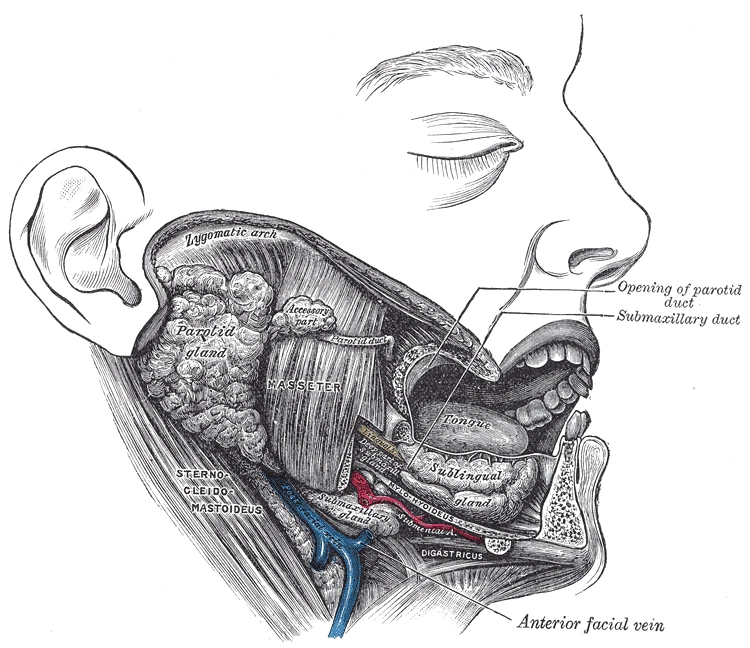 The salivary glands of the right side: the parotid, the submandibular (labelled submaxillary) and the sublingual, Gray's Anatomy, 1918, figure 1024Wikimedia Commons, Henry Vandyke Carter, Public domain (Gray1024.png)
Together they make about a litre a day, little during sleep and most at meals. Mucus in saliva wets the food so that it slides down. An enzyme, amylase, starts splitting starch into sugar, which is why bread chewed for a long time begins to taste sweet. Saliva also washes the teeth and carries antibodies and enzymes that kill bacteria.
Sources
- Susan Standring (ed.), Gray's Anatomy, 42nd ed. (2020), chapter on the mouth.
- Arthur Guyton and John Hall, Textbook of Medical Physiology, 13th ed. (2016), ch. 65 and 66.
Prev: The tongueNext: The throat