Bands and pouches
Along most of the colon the outer layer of muscle is gathered into three flat bands, the taeniae coli. They start together at the base of the appendix, which surgeons find by following them, and spread out again over the rectum. The bands are shorter than the tube, so they pucker its wall into a row of pouches, the haustra.
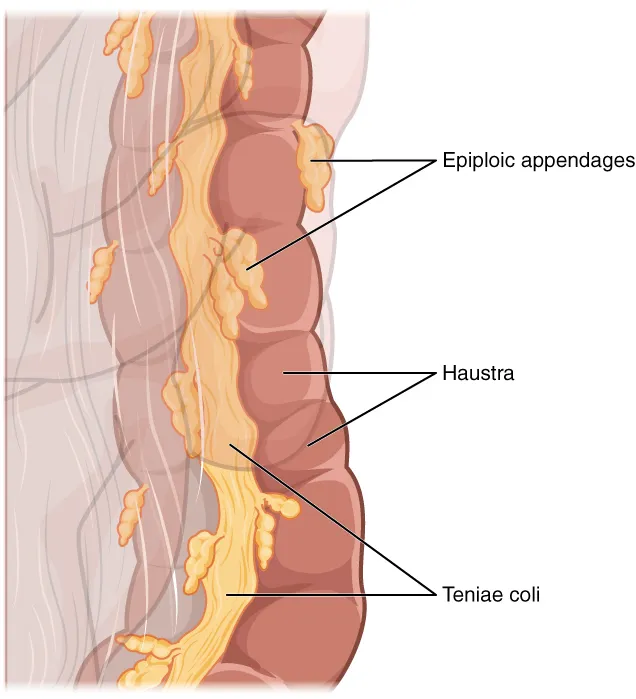 The wall of the colon: a taenia coli, the pouches called haustra and small bags of fat, OpenStax Anatomy and PhysiologyWikimedia Commons, OpenStax College, CC BY 3.0 (2433 Teniae Coli Haustra Epiploic Appendage.jpg)
The ring muscle squeezes a few pouches at a time. Each contraction builds over about 30 seconds and fades over the next minute, rolling the contents against the wall so that water and salt can be absorbed. Small bags of fat hang from the outer surface along the bands.
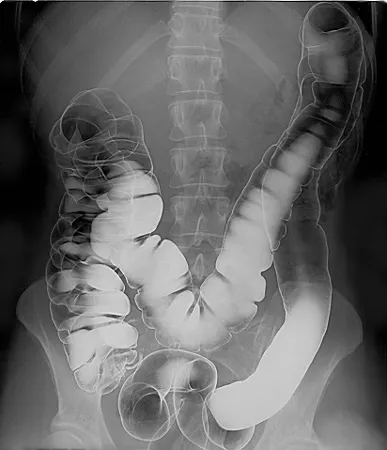 The large intestine on an X-ray, outlined by barium and air, with its pouches visibleWikimedia Commons, Glitzy queen00, Public domain (Human intestinal tract, as imaged via double-contrast barium enema.jpg)
Sources
- Susan Standring (ed.), Gray's Anatomy, 42nd ed. (2020), chapter on the large intestine.
- Arthur Guyton and John Hall, Textbook of Medical Physiology, 13th ed. (2016), ch. 64.
Prev: Cecum and appendixNext: The bacteria