Teeth
An adult has 32 teeth, eight in each half of each jaw: two incisors at the front, one canine, two premolars and three molars. The third molars, the wisdom teeth, often never come through, as in this model. A child has 20 milk teeth, which the permanent set begins to replace at about the age of six.
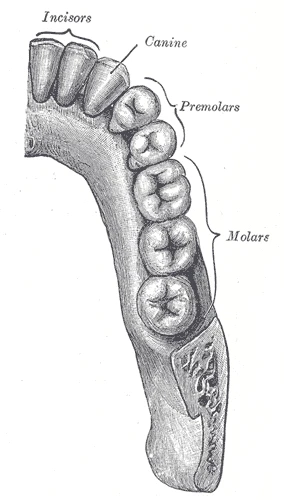 The permanent teeth of the right half of the lower jaw seen from above: two incisors, a canine, two premolars and three molars, Gray's Anatomy, 1918, figure 997Wikimedia Commons, Henry Vandyke Carter, Public domain (Gray997.png)
The incisors cut, the canines grip and tear, and the premolars and molars crush and grind. The jaw muscles can close the teeth with a force of about 25 kg on the incisors and 90 kg on the molars. Chewing breaks food into small pieces with a large surface, which the enzymes can then reach.
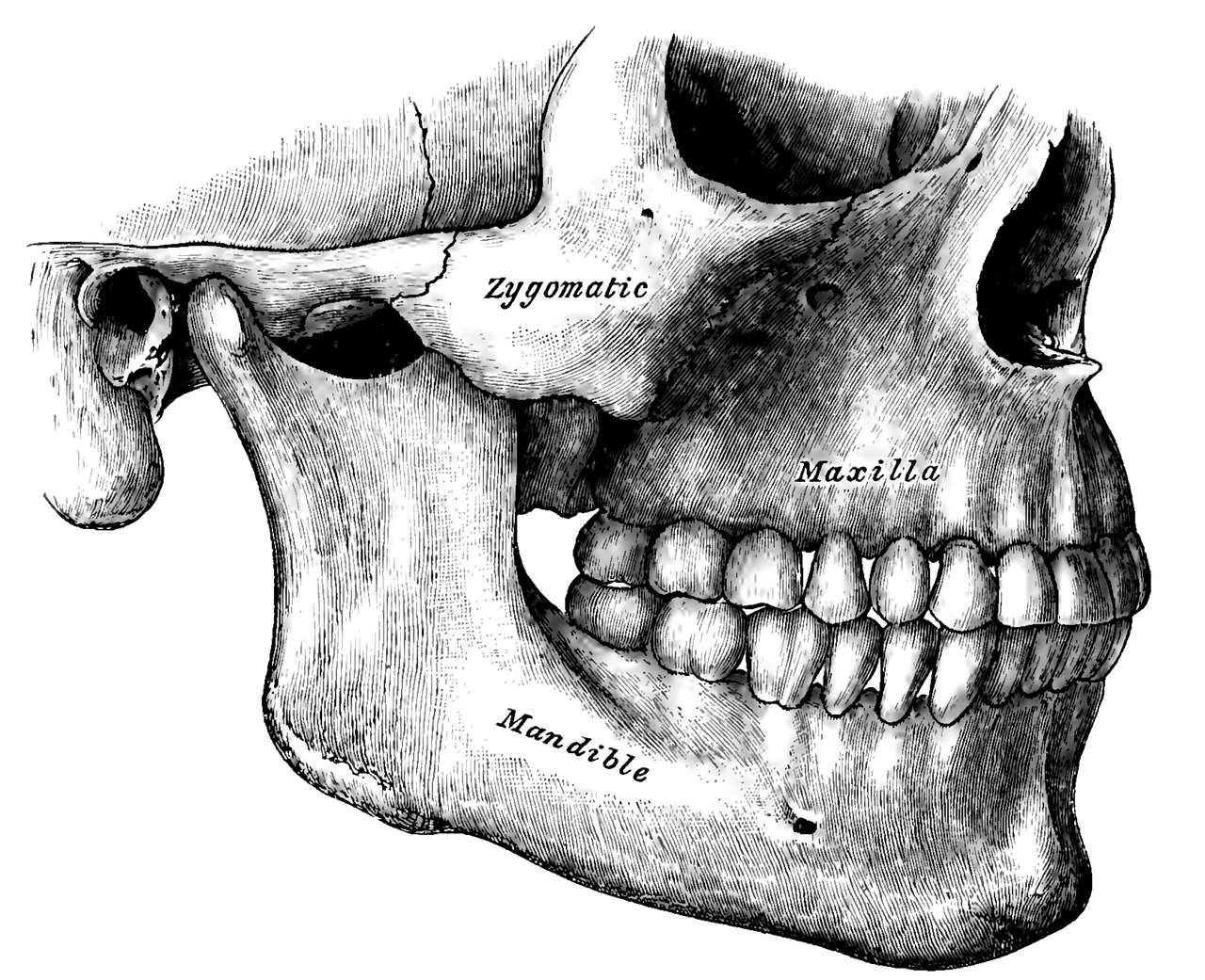 Side view of the teeth and jaws, Gray's Anatomy, 1918, figure 995Wikimedia Commons, Henry Vandyke Carter, Public domain (Gray995.png)
Enamel, the white cap of each tooth, is about 96 percent mineral and the hardest tissue in the body. It holds no living cells, so once decay breaks through it the enamel cannot repair itself.
Sources
- Susan Standring (ed.), Gray's Anatomy, 42nd ed. (2020), chapter on the mouth.
- Arthur Guyton and John Hall, Textbook of Medical Physiology, 13th ed. (2016), ch. 64.
Prev: The glands that pour inNext: The tongue