Where the ducts open
The duodenum, the first 25 cm of small intestine, curves round the head of the pancreas. Its name comes from the Latin for twelve, its length in finger breadths. In its descending part the bile duct and the pancreatic duct usually join and open on a small mound, the major duodenal papilla, guarded by a ring of muscle.
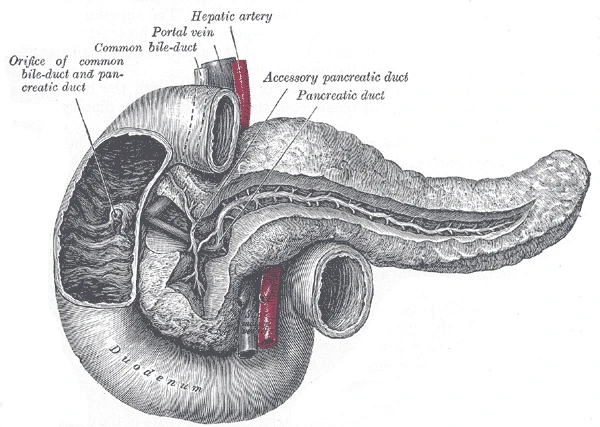 The duodenum opened to show the shared opening of the bile duct and the pancreatic duct, Gray's Anatomy, 1918, figure 1100Wikimedia Commons, Henry Vandyke Carter, Public domain (Gray1100.png)
Chyme arrives from the stomach at a pH of about 2. When acid touches the duodenal lining, its cells release secretin into the blood, and the pancreas answers with a juice rich in bicarbonate that neutralises the acid. Secretin, found by William Bayliss and Ernest Starling in 1902, was the first hormone to be discovered.
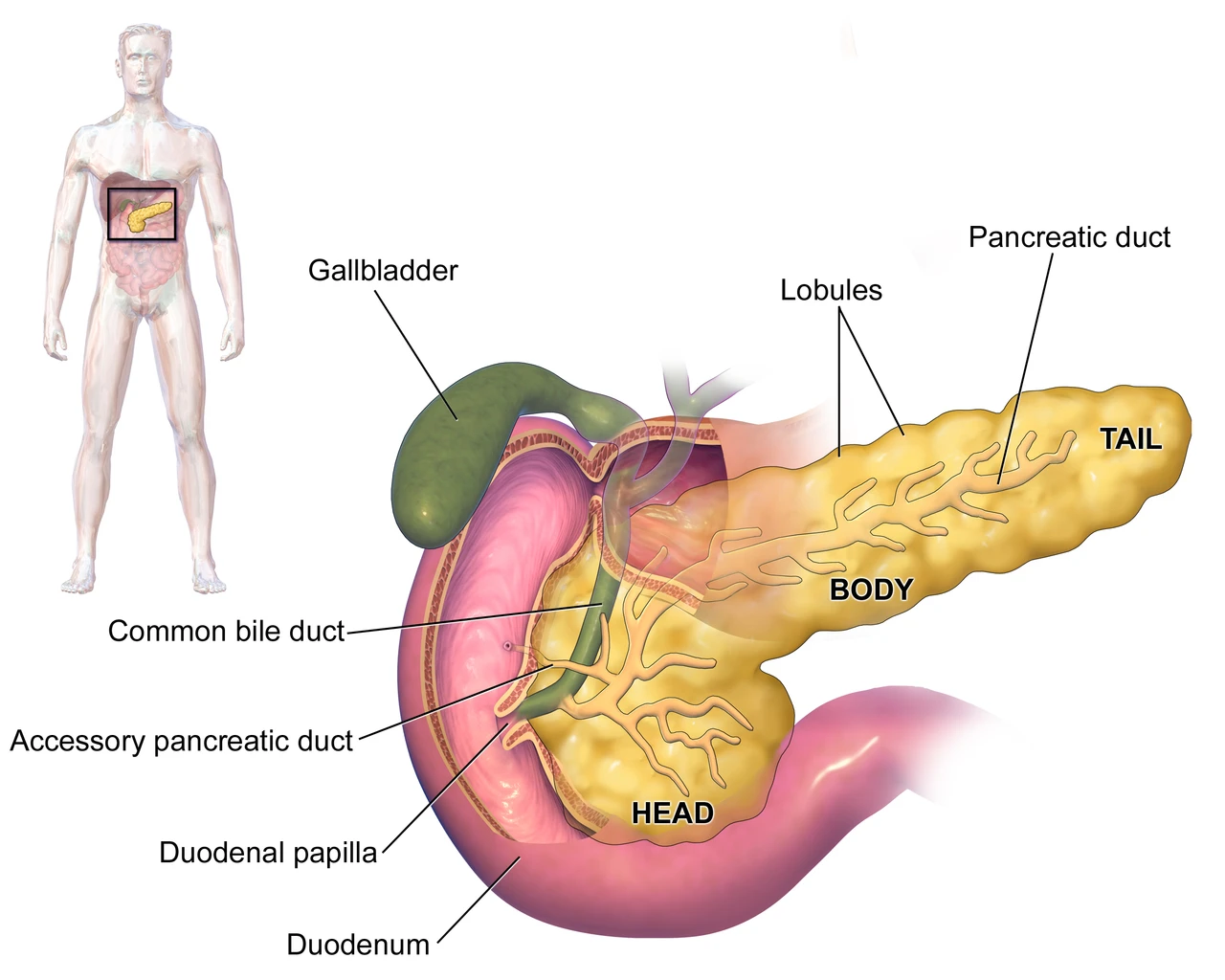 The pancreas and its ducts, which open with the bile duct into the duodenum, Blausen MedicalWikimedia Commons, BruceBlaus (Blausen Medical), CC BY 3.0 (Blausen 0699 PancreasAnatomy2.png)
Sources
- Susan Standring (ed.), Gray's Anatomy, 42nd ed. (2020), chapters on the small intestine and on the gallbladder and biliary tree.
- Arthur Guyton and John Hall, Textbook of Medical Physiology, 13th ed. (2016), ch. 65.
- William Bayliss and Ernest Starling, The mechanism of pancreatic secretion, Journal of Physiology 28 (1902): 325 to 353.
Prev: Chyme and the pylorusNext: The pancreas