Through the diaphragm
The esophagus passes into the abdomen through an opening in the diaphragm, the hiatus, at the level of the tenth thoracic vertebra. Its last few centimetres form the lower esophageal sphincter, a ring of muscle that stays closed between swallows. It relaxes as a swallow arrives and lets the bolus into the stomach.
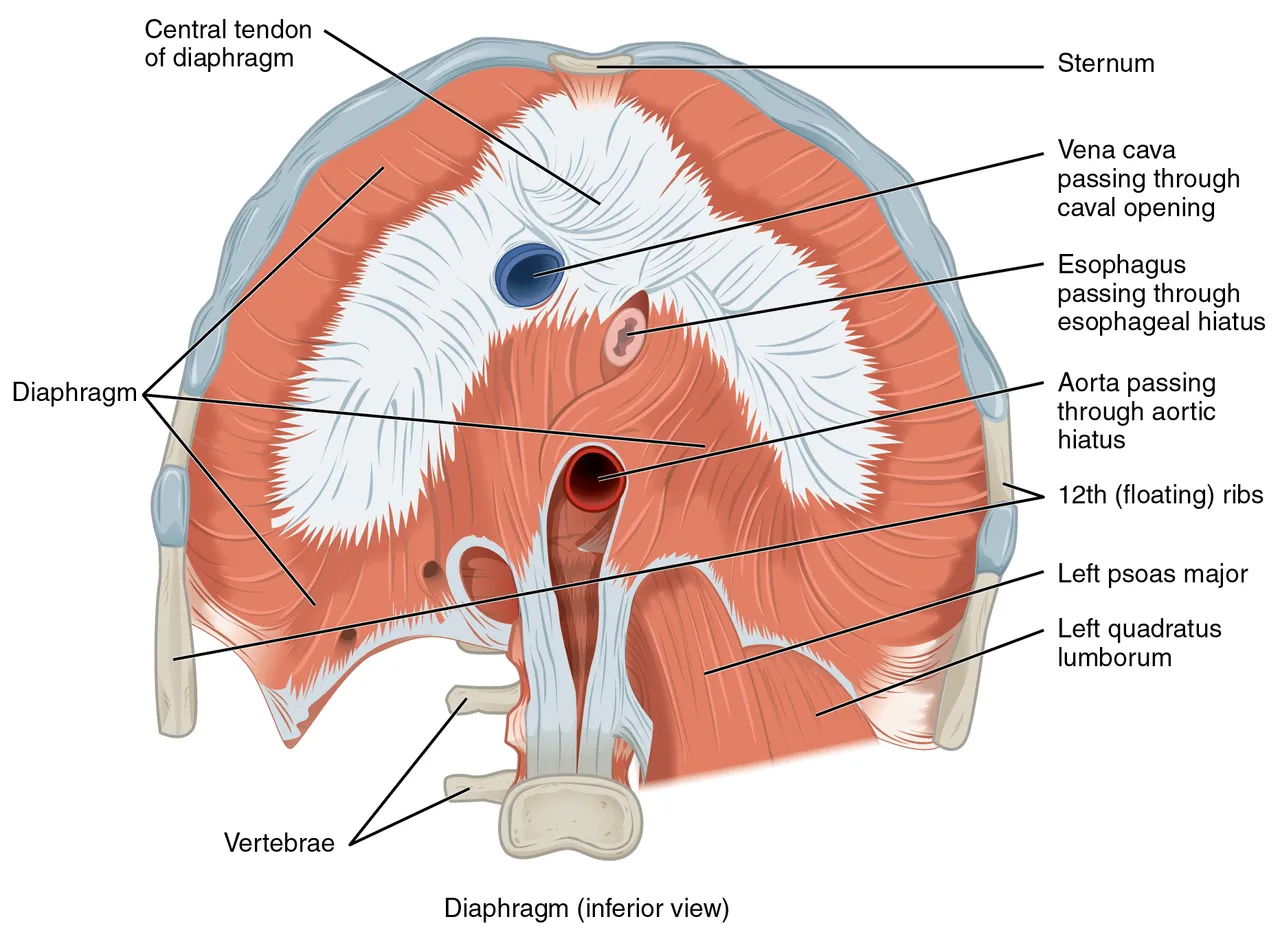 The diaphragm from below, with the esophagus passing through its hiatus, OpenStax Anatomy and PhysiologyWikimedia Commons, OpenStax, CC BY 4.0 (1113 The Diaphragm.jpg)
This closure, helped by the diaphragm round the hiatus, keeps acid in the stomach. The lining of the esophagus has little defence against acid. When stomach contents flow back they cause heartburn, a burning pain behind the breastbone. In a hiatus hernia part of the stomach slides up through the opening into the chest, and backflow becomes more likely.
Sources
- Susan Standring (ed.), Gray's Anatomy, 42nd ed. (2020), chapter on the abdominal oesophagus and stomach.
- Arthur Guyton and John Hall, Textbook of Medical Physiology, 13th ed. (2016), ch. 64 and 67.
Prev: The esophagusNext: A bag of muscle