The largest gland
The liver is the largest gland in the body, about 1.5 kg in an adult. It fills the upper right of the abdomen under the dome of the diaphragm, sheltered by the lower ribs, and reaches across to the left above the stomach. The gallbladder hangs under its right lobe.
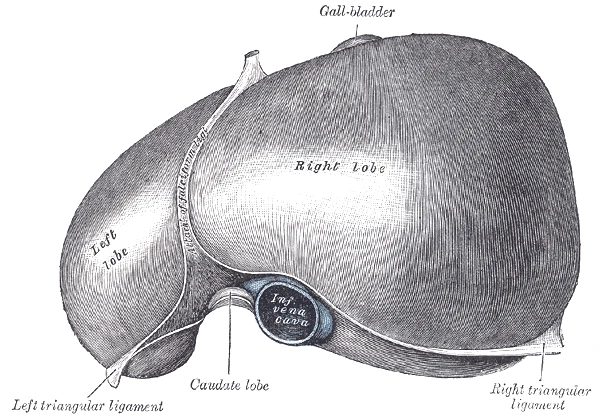 The upper surface of the liver, with its right and left lobes, Gray's Anatomy, 1918, figure 1085Wikimedia Commons, Henry Vandyke Carter, Public domain (Gray1085.png)
Surgeons divide the liver into eight segments, each with its own branch of the blood vessels and bile ducts, so that one can be removed and the others keep working. This model's liver is built from those eight. If up to 70 percent of a healthy liver is removed, the rest grows back to the former size.
Under the microscope the liver is made of 50,000 to 100,000 lobules, each one to two millimetres across. In each lobule, plates of liver cells run out from a central vein.
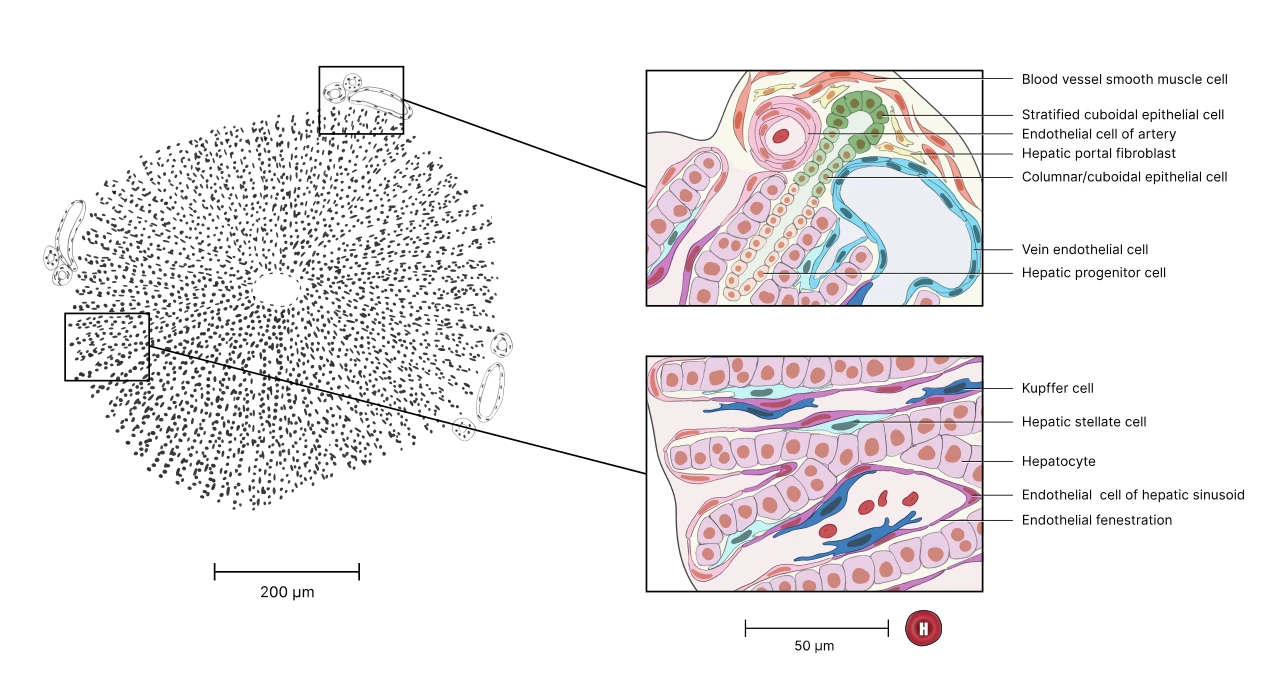 A liver lobule: plates of liver cells round a central vein, with portal tracts at its edgeWikimedia Commons, NIAID NIH BioArt, Human Reference Atlas, CC BY 4.0 (Liver Lobule (NIH BioArt 565).svg)
Sources
- Susan Standring (ed.), Gray's Anatomy, 42nd ed. (2020), chapter on the liver.
- Arthur Guyton and John Hall, Textbook of Medical Physiology, 13th ed. (2016), ch. 71.
Prev: Holding onNext: Blood from the gut