A bag of muscle
The stomach is a J-shaped bag under the left ribs, between the esophagus and the duodenum. Its dome, the fundus, rises above the entrance and usually holds a bubble of swallowed air. Below it lie the body and the antrum, which narrows to the pylorus, the outlet. Part of the stomach lies behind the liver.
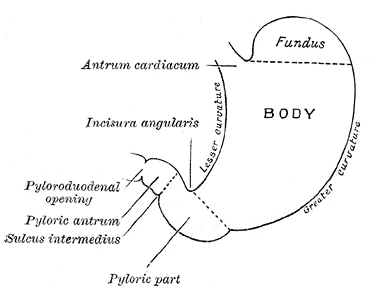 Outline of the stomach and its parts: fundus, body and pyloric part, Gray's Anatomy, 1918, figure 1046Wikimedia Commons, Henry Vandyke Carter, Public domain (Gray1046.png)
Empty, its lining lies in deep folds. As food arrives the wall relaxes, so the stomach takes in 0.8 to 1.5 litres before the pressure inside rises. The wall has three layers of smooth muscle, the innermost running obliquely, which lets the stomach knead its contents in every direction.
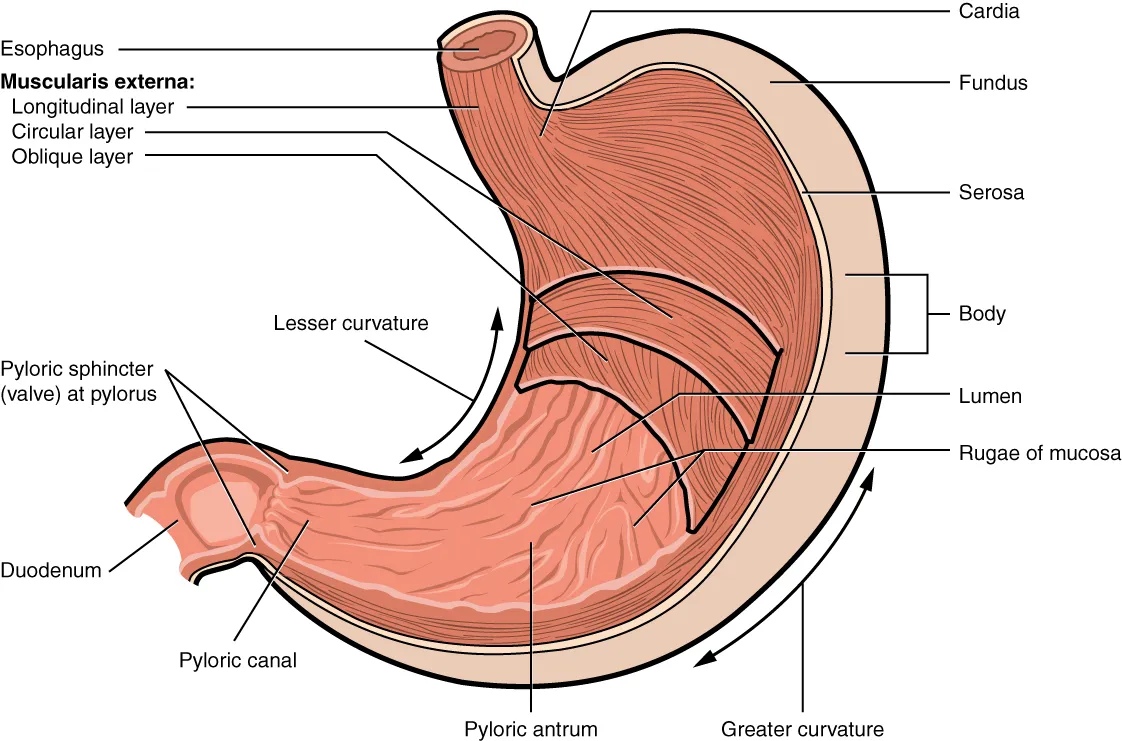 The stomach opened, showing its folds and its three layers of muscle, OpenStax Anatomy and PhysiologyWikimedia Commons, OpenStax College, CC BY 3.0 (2414 Stomach.jpg)
Sources
- Susan Standring (ed.), Gray's Anatomy, 42nd ed. (2020), chapter on the abdominal oesophagus and stomach.
- Arthur Guyton and John Hall, Textbook of Medical Physiology, 13th ed. (2016), ch. 64.
Prev: Through the diaphragmNext: Acid and pepsin