The throat
Behind the mouth the food path crosses the airway. The pharynx, a funnel of muscle 12 to 14 cm long, leads from behind the nose down to the esophagus, and air passes through it on its way to the larynx. Once the tongue pushes a bolus back into it, swallowing runs as a reflex that cannot be stopped halfway.
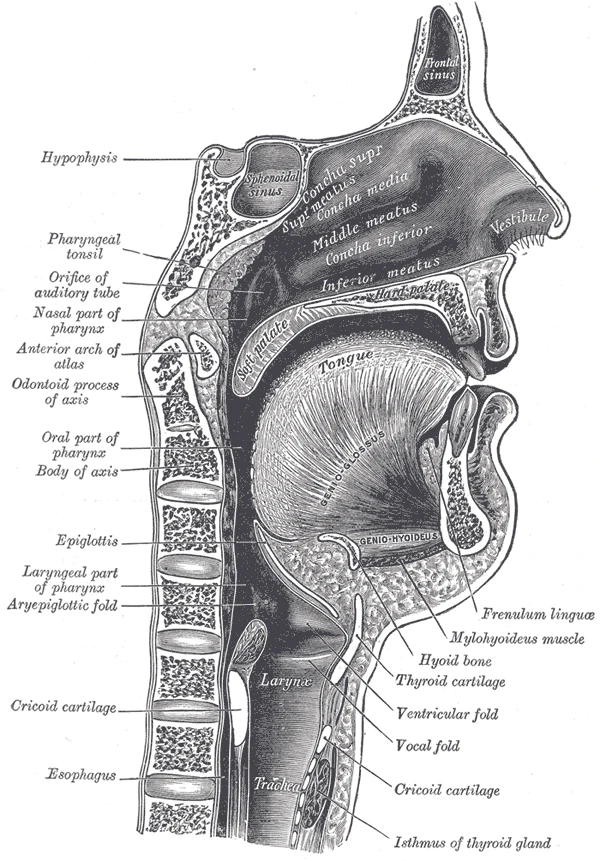 The head and neck cut down the middle: nose, mouth, pharynx, larynx and the start of the esophagus, Gray's Anatomy, 1918, figure 994Wikimedia Commons, Henry Vandyke Carter, Public domain (Gray994.png)
In about a second the soft palate rises to close off the nose, the larynx is pulled up and forward under the tongue, and the epiglottis tips back over its entrance. Breathing stops for that moment. Then the muscle of the pharynx squeezes from the top down and pushes the bolus into the esophagus.
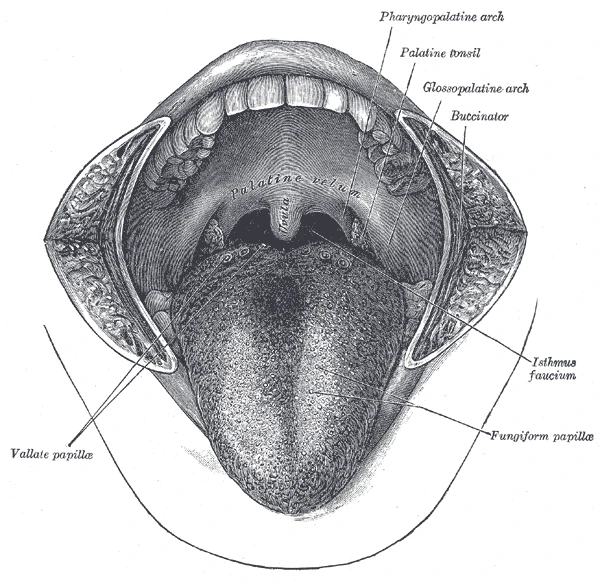 The mouth opened wide, with the tongue pulled forward under the soft palate and uvula, and the palatine tonsils at the sides of the throat, Gray's Anatomy, 1918, figure 1014Wikimedia Commons, Henry Vandyke Carter, Public domain (Gray1014.png)
Sources
- Susan Standring (ed.), Gray's Anatomy, 42nd ed. (2020), chapter on the pharynx.
- Arthur Guyton and John Hall, Textbook of Medical Physiology, 13th ed. (2016), ch. 64.
Prev: SalivaNext: The esophagus