From mouth to anus
Everything you eat passes through one tube from the mouth to the anus. Its parts follow each other in order: the pharynx, the esophagus, the stomach, the small intestine and the large intestine. Measured after death, with its muscle slack, the small intestine alone is about six metres long and the large intestine one and a half.
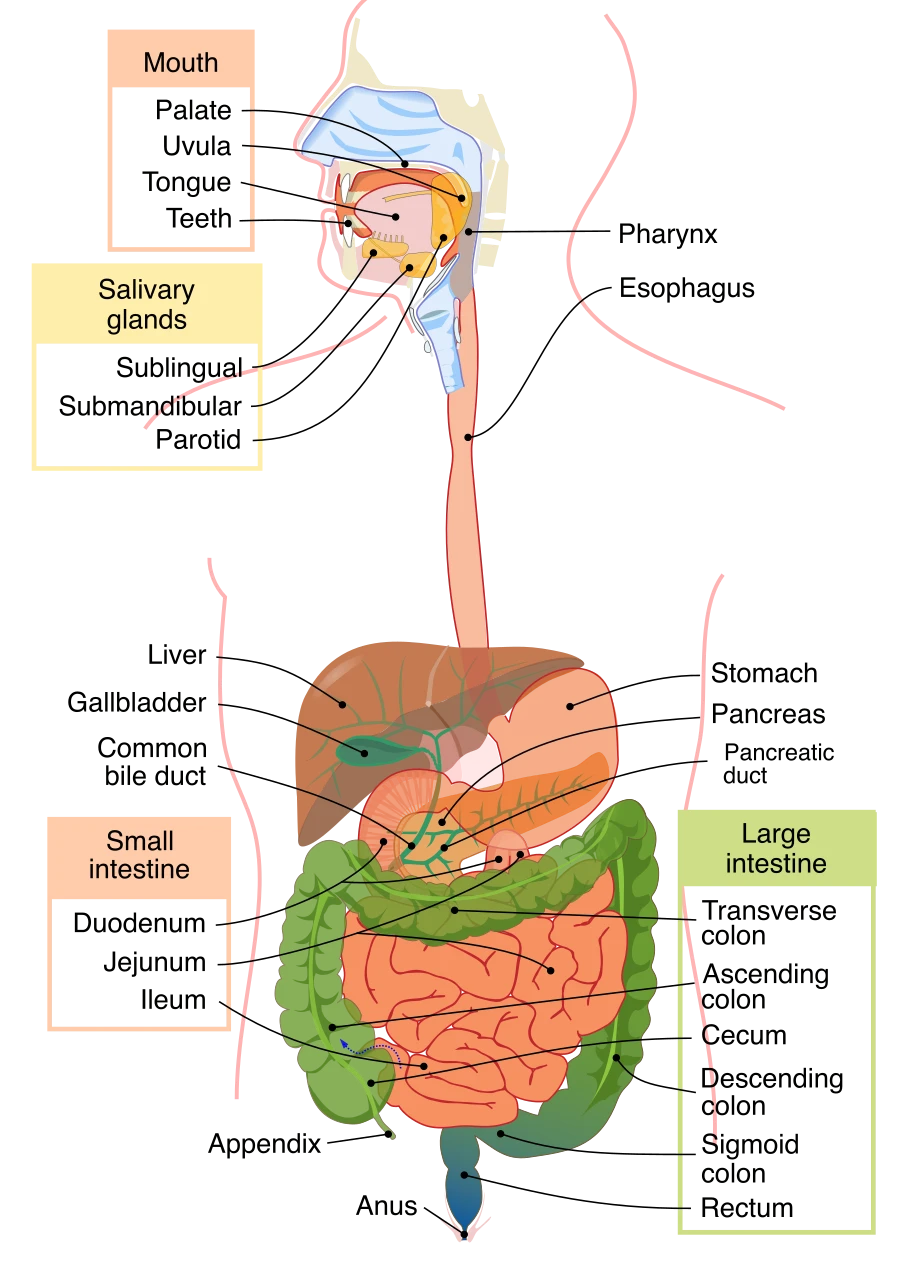 The digestive tract and the glands that empty into it, labelled diagramWikimedia Commons, Mariana Ruiz and Jmarchn, Public domain (Digestive system diagram en.svg)
The tube does two kinds of work. Teeth and the muscle in its wall break up and mix the food. Enzymes from glands then cut it into molecules small enough to cross the wall into the blood: sugars, amino acids and fatty acids. What the body cannot use leaves at the far end, usually a day or two later.
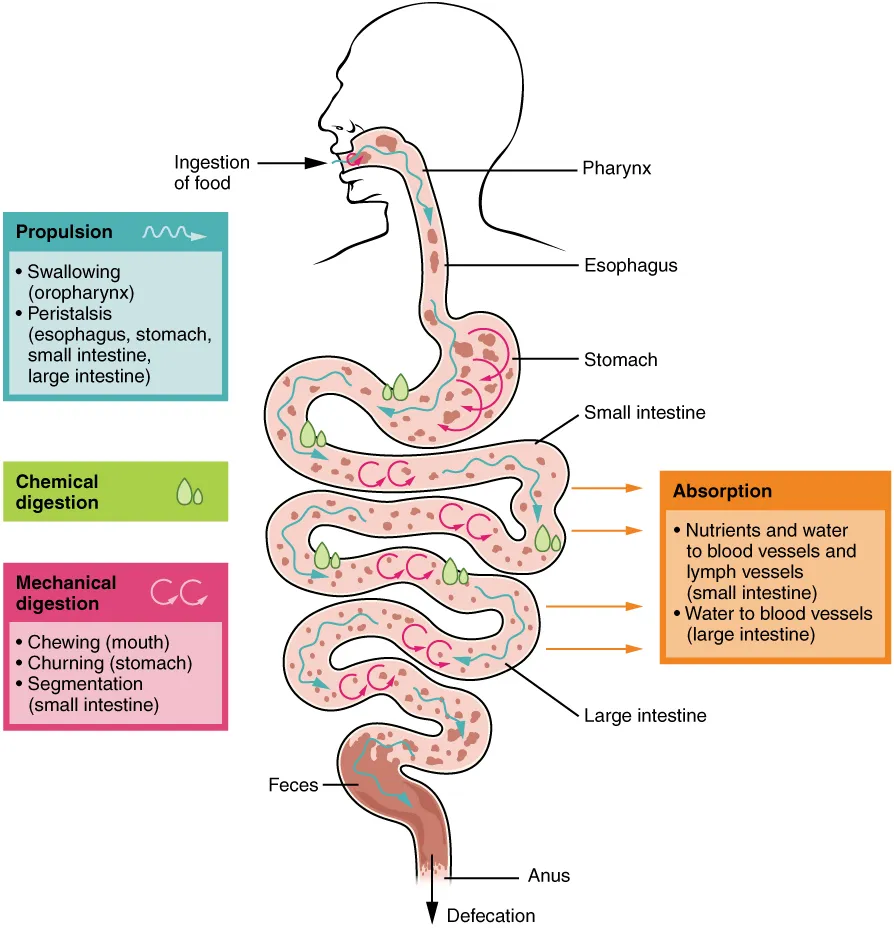 The work of the tract: swallowing and peristalsis, mechanical and chemical digestion, absorption and defecation, OpenStax Anatomy and PhysiologyWikimedia Commons, OpenStax College, CC BY 3.0 (2405 Digestive Process.jpg)
Sources
- Susan Standring (ed.), Gray's Anatomy, 42nd ed. (2020), chapters on the stomach, the small intestine and the large intestine.
- Arthur Guyton and John Hall, Textbook of Medical Physiology, 13th ed. (2016), ch. 63.
Next: The glands that pour in