The tongue
The tongue is a mass of muscle covered with a moist lining. Muscles inside it change its shape, and muscles from the jaw and the hyoid bone move it. While you chew it pushes food between the teeth and mixes it with saliva into a soft lump, the bolus. Then it pushes the bolus back into the throat.
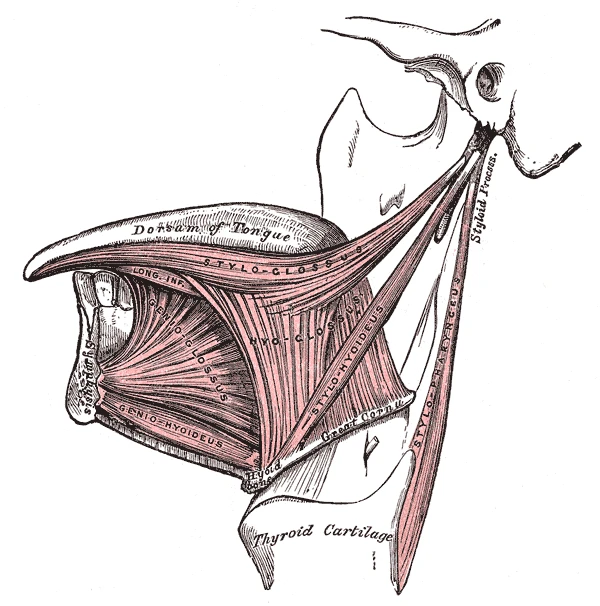 The muscles that move the tongue from the jaw, the hyoid bone and the skull, left side, Gray's Anatomy, 1918, figure 1019Wikimedia Commons, Henry Vandyke Carter, Public domain (Gray1019.png)
Its upper surface is rough with small projections, the papillae. Most taste buds sit on them, some 3,000 to 10,000 in an adult, each a cluster of about 50 cells.
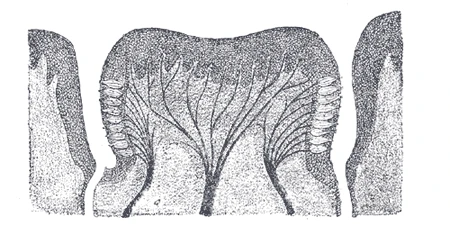 A vallate papilla of the tongue cut through, with its taste buds and nerves, Gray's Anatomy, 1918, figure 1015Wikimedia Commons, Henry Vandyke Carter, Public domain (Gray1015.png)
Taste buds tell five tastes: sweet, sour, salty, bitter and umami, the taste of meat broth. Most of what we call flavour comes from smell, which is why food tastes flat with a blocked nose.
Sources
- Susan Standring (ed.), Gray's Anatomy, 42nd ed. (2020), chapter on the mouth.
- Arthur Guyton and John Hall, Textbook of Medical Physiology, 13th ed. (2016), ch. 54 and 64.
Prev: TeethNext: Saliva