Born in the marrow
Every lymphocyte starts in the red marrow, which in an adult survives in the skull, the breastbone, the vertebrae, the pelvis and the top of each thighbone. It comes from the same stem cells as red cells and platelets. The B cells finish their training in the marrow itself. Young T cells leave in the blood for the thymus.
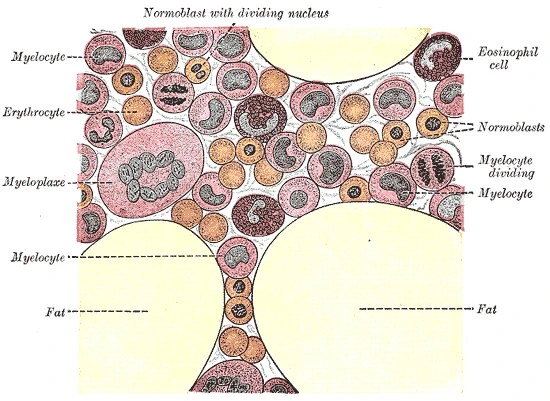 Red bone marrow, magnified: fat cells among the blood-forming cells, Gray's Anatomy, 1918, figure 72Wikimedia Commons, Henry Vandyke Carter, Public domain (Gray72.png)
B cells are named for the bursa of Fabricius, a pouch beside the gut of birds. In 1956 Bruce Glick found that chickens without one made no antibodies. Humans have no bursa, and the marrow does its work. Marrow and thymus make the lymphocytes. The nodes, spleen, tonsils and gut patches are where they meet germs.
Sources
- Arthur Guyton and John Hall, Textbook of Medical Physiology, 13th ed. (2016), ch. 33 and 35.
- Bruce Glick, T. S. Chang and R. George Jaap, The bursa of Fabricius and antibody production, Poultry Science 35 (1956), 224-225.
Prev: A school for T cellsNext: Cells on patrol