Cells on patrol
Only about 2 in 100 of the body's lymphocytes are in the blood at any moment. The rest sit in the nodes, the spleen, the marrow, the thymus and the wall of the gut.
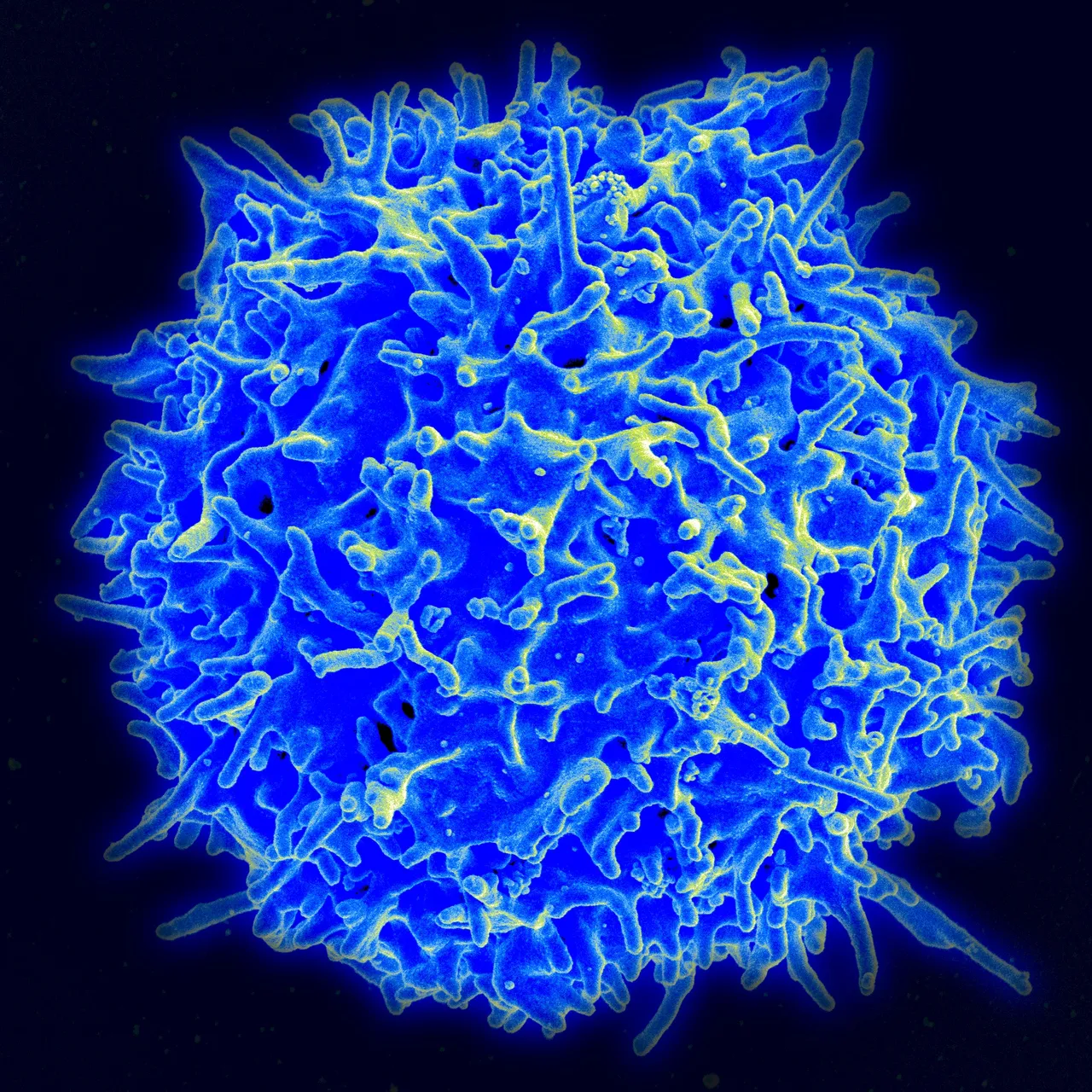 A human T cell from a healthy donor, scanning electron micrograph in false colour, NIAIDWikimedia Commons, NIAID/NIH, Public domain (Healthy Human T Cell.jpg)
They keep moving. A lymphocyte leaves the blood inside a node, spends some hours there, and returns with the lymph through the thoracic duct and the great veins of the neck. Then it enters another node. In this way the few cells that recognize one germ can search the whole body for it.
When a lymphocyte meets its germ, it divides again and again. A node filling with dividing cells grows tender and swollen, the swollen gland of an infection.
Sources
- Arthur Guyton and John Hall, Textbook of Medical Physiology, 13th ed. (2016), ch. 34 and 35.
- Thomas Westermann and Reinhard Pabst, Distribution of lymphocyte subsets and natural killer cells in the human body, The Clinical Investigator 70 (1992), 539-544.
Prev: Born in the marrowNext: The tonsils