Leaving the capillaries
Blood reaches the thigh by the femoral artery and leaves it by the femoral vein. In between it runs through capillaries, tubes with a wall one cell thick. The pressure of the blood pushes water and small molecules out through that wall into the spaces between the cells, which take what they need.
The plasma proteins are too large to cross, and they draw water back in by osmosis. Along the capillary the push falls while the pull holds, so most of the fluid returns. Across the whole body a little more leaves than returns, about 2 to 3 litres a day, with some protein that leaks through.
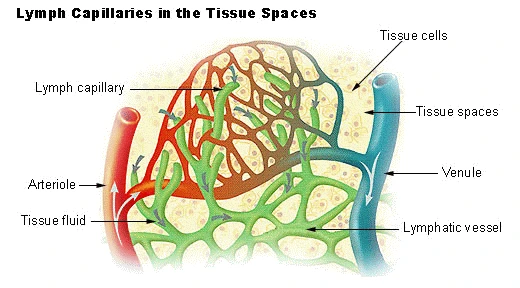 Lymph capillaries among the tissue cells between an arteriole and a venule: tissue fluid enters them and drains into a lymphatic vessel, SEER Training, U.S. National Cancer InstituteWikimedia Commons, SEER, U.S. National Cancer Institute, Public domain (Illu lymph capillary.png)
Only the lymph vessels can carry that protein back to the blood. Without them, Guyton and Hall write, a person would die within about 24 hours.
Sources
- Arthur Guyton and John Hall, Textbook of Medical Physiology, 13th ed. (2016), ch. 16.
Prev: A second networkNext: The first lymph vessels