Blocked lymph
When lymph vessels or nodes are missing, damaged or blocked, fluid rich in protein gathers in the tissue: lymphoedema. Over time the tissue lays down fibres and fat and grows hard. After the nodes around the axillary vessels are removed or irradiated for breast cancer, about one woman in five develops a swollen arm.
Worldwide the commonest cause is lymphatic filariasis. Mosquitoes carry the larvae of thread-like worms, mostly Wuchereria bancrofti, which settle and breed in the lymph vessels. After years the legs can swell to many times their size, which is called elephantiasis. Drugs given once a year to whole communities have cut the number of infected people sharply since 2000.
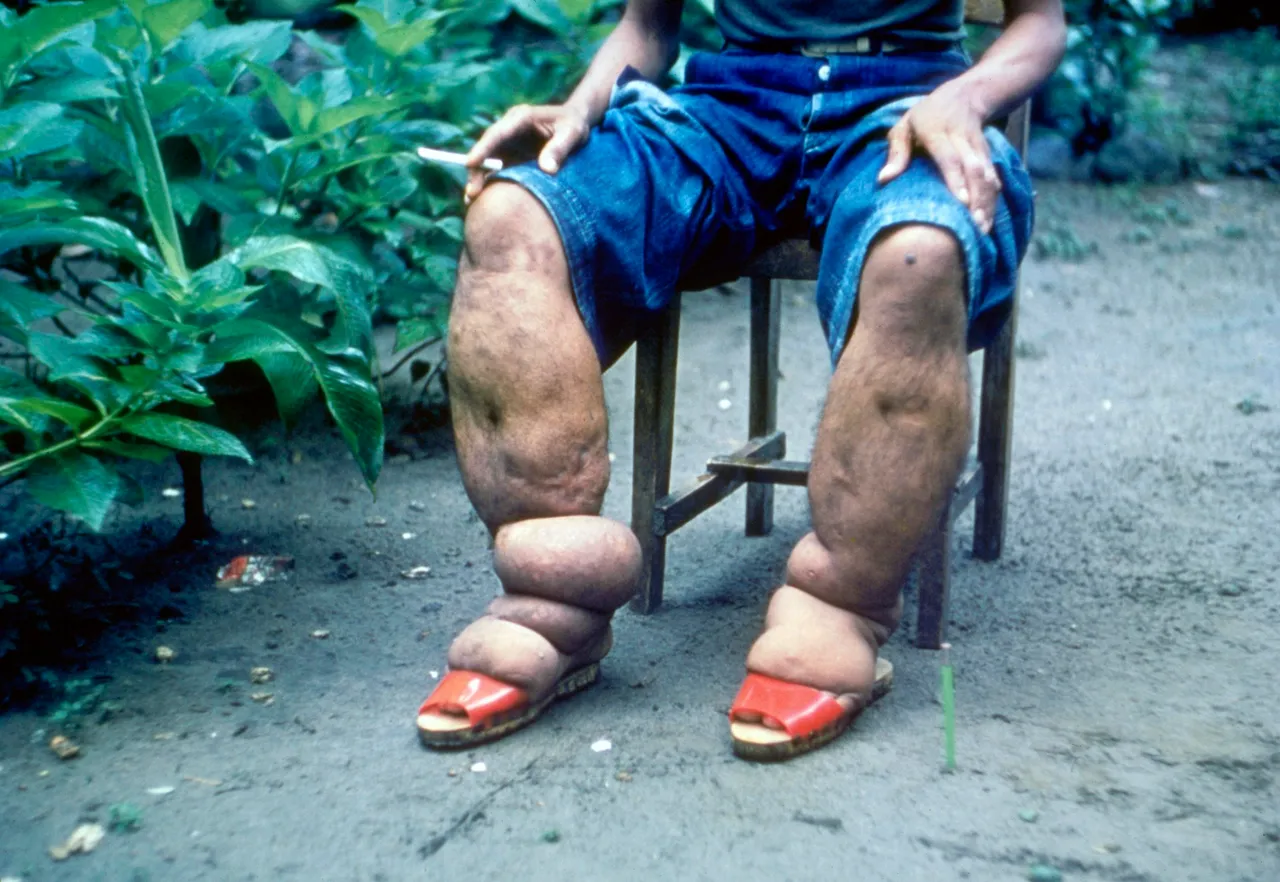 Elephantiasis of the legs from lymphatic filariasis, Luzon, Philippines, 1962, CDC Public Health Image LibraryWikimedia Commons, Centers for Disease Control and Prevention, Public domain (Elephantiasis.jpg)
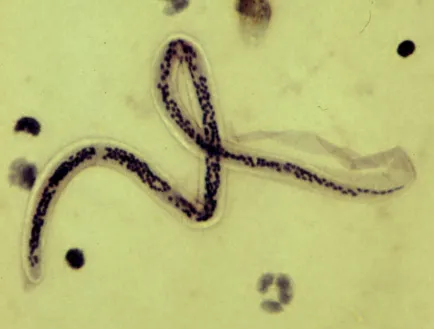 A larva of Wuchereria bancrofti, a microfilaria, in a blood smear stained with haematoxylin, CDC DPDxWikimedia Commons, Centers for Disease Control and Prevention, DPDx, Public domain (Wuchereria bancrofti 1 DPDX.JPG)
Sources
- Arthur Guyton and John Hall, Textbook of Medical Physiology, 13th ed. (2016), ch. 25.
- Tracey DiSipio and others, Incidence of unilateral arm lymphoedema after breast cancer, The Lancet Oncology 14 (2013), 500-515.
- World Health Organization, Lymphatic filariasis, fact sheet (2023).
Prev: SwellingNext: Aselli's milky veins