Swelling
When more fluid leaves the capillaries than the lymph can carry, it collects between the cells as oedema. The lymph has a large reserve, and its flow can rise many times over before the tissues swell. Gravity draws the fluid to the lowest part of the body, so it shows first around the ankles.
The common causes either raise the pressure in the veins, as in heart failure or hours of standing, or lower the proteins in the plasma, as in starvation or disease of the liver or kidneys. Valves that fail in the great saphenous and femoral veins let blood pool in the legs and push fluid out.
A finger pressed into the swollen skin for a few seconds leaves a dent that fills slowly: pitting oedema.
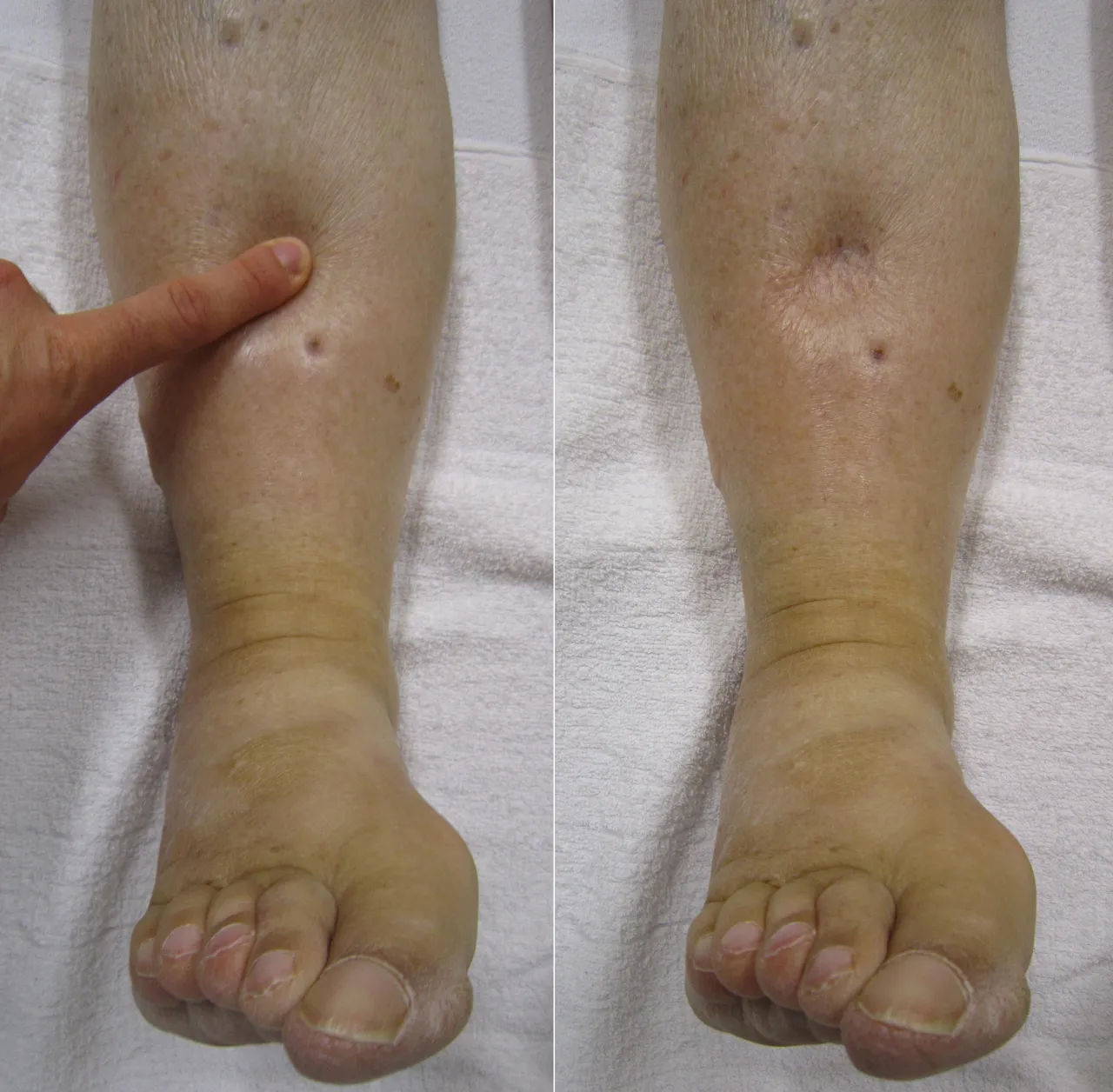 Pitting oedema: a finger pressed into a swollen lower leg leaves a dentWikimedia Commons, James Heilman, MD, CC BY-SA 3.0 (Combinpedal.jpg)
Sources
- Arthur Guyton and John Hall, Textbook of Medical Physiology, 13th ed. (2016), ch. 16 and 25.
Prev: Milky lymphNext: Blocked lymph