1651
Pecquet's cistern
Jean Pecquet, a medical student at Montpellier, was dissecting a dog when he saw white chyle well up from the veins above its heart. He traced it down a thin vessel along the spine to a sac on the lumbar vertebrae. He called it the receptacle of the chyle. Today it is the cisterna chyli.
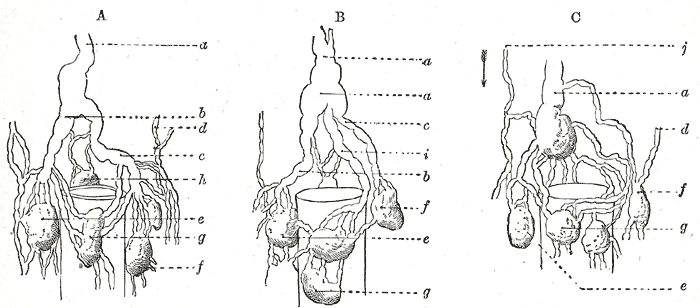 Three ways the thoracic duct begins, each with a cisterna chyli at its foot fed by trunks from the nodes beside the aorta, schematic, Gray's Anatomy, 1918, figure 600Wikimedia Commons, Henry Vandyke Carter, Public domain (Gray600.png)
The vessel was the thoracic duct, and it ended in the left subclavian vein. The chyle went to the superior vena cava and the heart, and the liver had no part in it, against what Aselli and Galen had held. Pecquet published the finding in Paris in 1651, in his Experimenta nova anatomica.
Sources
- Jean Pecquet, Experimenta nova anatomica (Paris, 1651).
Prev: Aselli's milky veinsNext: Rudbeck and Bartholin