The mesentery
The mesentery is a fan-shaped fold that ties the small intestine to the back wall of the abdomen and carries its vessels. Between its two layers lie 100 to 150 nodes, strung along the branches of the superior mesenteric artery and vein.
They take the lymph of the small intestine, white with fat after a meal, and whatever crossed the gut wall. From them it passes to nodes in front of the aorta, at the root of the artery, and on to the cisterna chyli. In children an infection can swell these nodes and cause a pain easily taken for appendicitis.
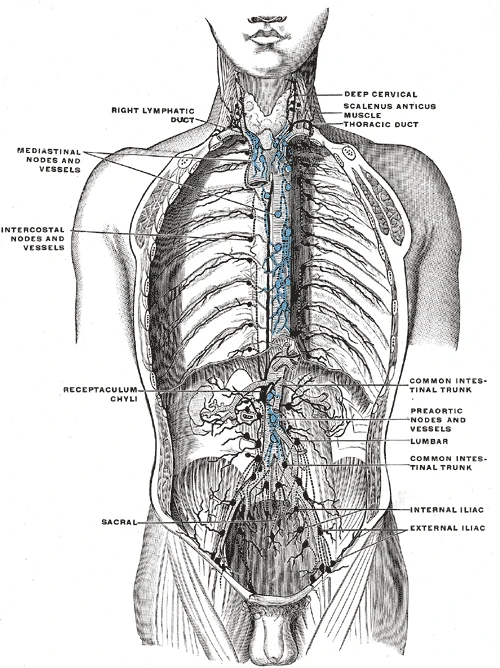 The lymph vessels and nodes of the chest and abdomen: the preaortic nodes and the intestinal trunks lead to the receptaculum chyli and the thoracic duct, diagrammatic, Gray's Anatomy, 1918, figure 621Wikimedia Commons, Henry Vandyke Carter, Public domain (Gray621.png)
Sources
- Susan Standring (ed.), Gray's Anatomy, 42nd ed. (2020), chapter on the small intestine.
- Henry Gray, Anatomy of the Human Body, 20th ed. (1918), section VIII, The Lymphatics of the Abdomen and Pelvis.
Prev: The chestNext: The spleen