The neck
Every lymph vessel of the head and neck ends in the deep cervical nodes. They form a chain along the internal jugular vein, from the base of the skull to the root of the neck, beside the common carotid artery. Smaller groups under the jaw and chin, behind the ear and at the back of the head drain into it.
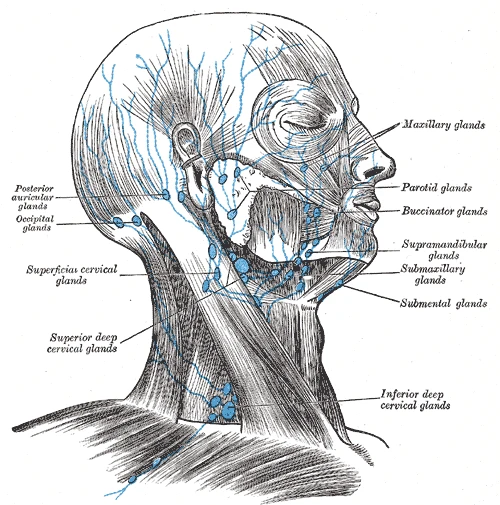 The superficial lymph nodes and vessels of the head and neck, with the superior and inferior deep cervical nodes, Gray's Anatomy, 1918, figure 602Wikimedia Commons, Henry Vandyke Carter, Public domain (Gray602.png)
In a sore throat the node just below the angle of the jaw swells and aches, because the tonsil drains to it.
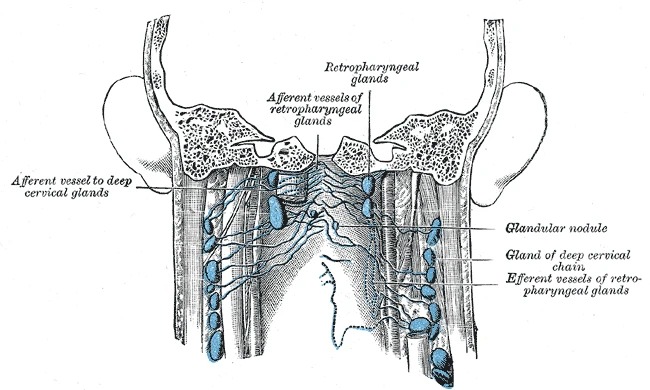 The lymph vessels of the pharynx seen from behind, running to the retropharyngeal nodes and the chain of deep cervical nodes, Gray's Anatomy, 1918, figure 603Wikimedia Commons, Henry Vandyke Carter, Public domain (Gray603.png)
Low on the left, near the end of the thoracic duct, sits a node that can catch cancer cells carried up from the abdomen. When a cancer of the stomach enlarges it, doctors call it Virchow's node, after the pathologist who described it in 1848.
Sources
- Susan Standring (ed.), Gray's Anatomy, 42nd ed. (2020), chapter on the neck.
- Henry Gray, Anatomy of the Human Body, 20th ed. (1918), section VIII, The Lymphatics of the Head, Face, and Neck.
Prev: Inside a nodeNext: The armpit