The spleen
The spleen is the largest lymphoid organ, about 12 cm long and 150 g, tucked under the left ribs behind the stomach. It filters blood the way a node filters lymph. Blood arrives by the splenic artery and leaves by the splenic vein for the liver. Unlike a node, it has no lymph vessels bringing lymph in.
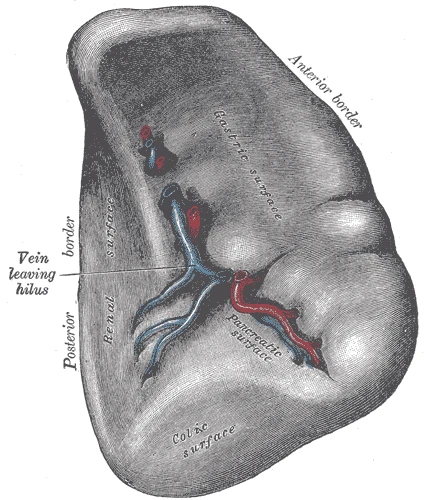 The spleen and its vessels, Gray's Anatomy, 1918, figure 1188Wikimedia Commons, Henry Vandyke Carter, Public domain (Gray1188.png)
Its lymphocytes meet the germs that reach the bloodstream. A blow to the left ribs can tear the spleen, and it is then often removed. A person without a spleen lives well but is more open to some bacteria, such as the pneumococcus, and is vaccinated against them.
Sources
- Susan Standring (ed.), Gray's Anatomy, 42nd ed. (2020), chapter on the spleen.
- Arthur Guyton and John Hall, Textbook of Medical Physiology, 13th ed. (2016), ch. 34.
Prev: The mesenteryNext: Red and white pulp