The thymus
The thymus lies behind the upper breastbone, in front of the heart and the great vessels, in two lobes. In a child it is large: about 15 g at birth and 30 to 40 g at puberty. After that it slowly turns to fat, and in old age only a few grams of working tissue remain inside a fatty remnant.
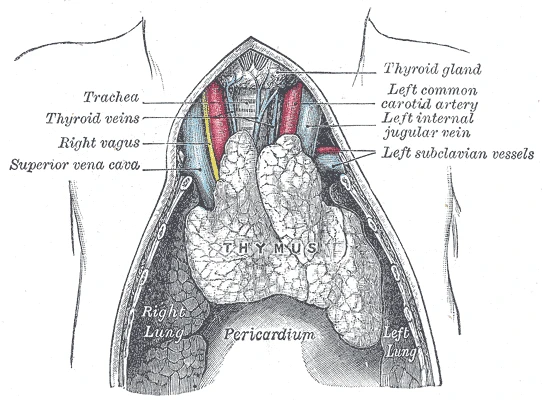 The thymus of a baby at full term, exposed in the chest: it lies on the pericardium between the lungs, below the thyroid gland, Gray's Anatomy, 1918, figure 1178Wikimedia Commons, Henry Vandyke Carter, Public domain (Gray1178.png)
Its job was unknown until 1961, when Jacques Miller removed it from newborn mice. They grew up short of lymphocytes, wasted away, and accepted skin grafts from other strains that normal mice rejected. The thymus is where one kind of lymphocyte matures, and those cells are named after it: T cells.
Sources
- Susan Standring (ed.), Gray's Anatomy, 42nd ed. (2020), ch. 4 and chapter on the mediastinum.
- Jacques Miller, Immunological function of the thymus, The Lancet 278 (1961), 748-749.
Prev: Red and white pulpNext: A school for T cells