The tonsils
Where air and food enter the throat, a ring of lymphoid tissue stands guard. The adenoid sits on the roof of the throat behind the nose. The two palatine tonsils, the ones a doctor sees, sit at the sides of the throat below the soft palate. The lingual tonsil covers the back of the tongue.
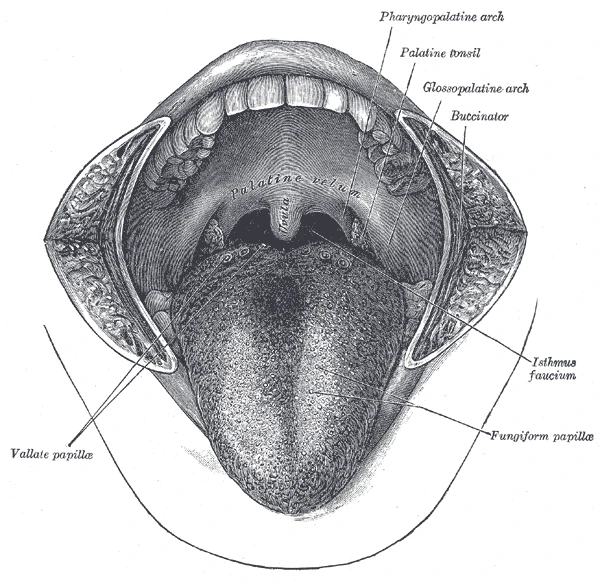 The mouth opened wide, with the tongue pulled forward under the soft palate and uvula, and the palatine tonsils at the sides of the throat, Gray's Anatomy, 1918, figure 1014Wikimedia Commons, Henry Vandyke Carter, Public domain (Gray1014.png)
The surface of a tonsil dips into deep pits, the crypts, where food and air leave samples for the lymphocytes beneath. The ring is largest in childhood and shrinks after puberty. Large adenoids can block breathing through the nose, and tonsils that are inflamed again and again are sometimes removed. Wilhelm Waldeyer described the ring in 1884.
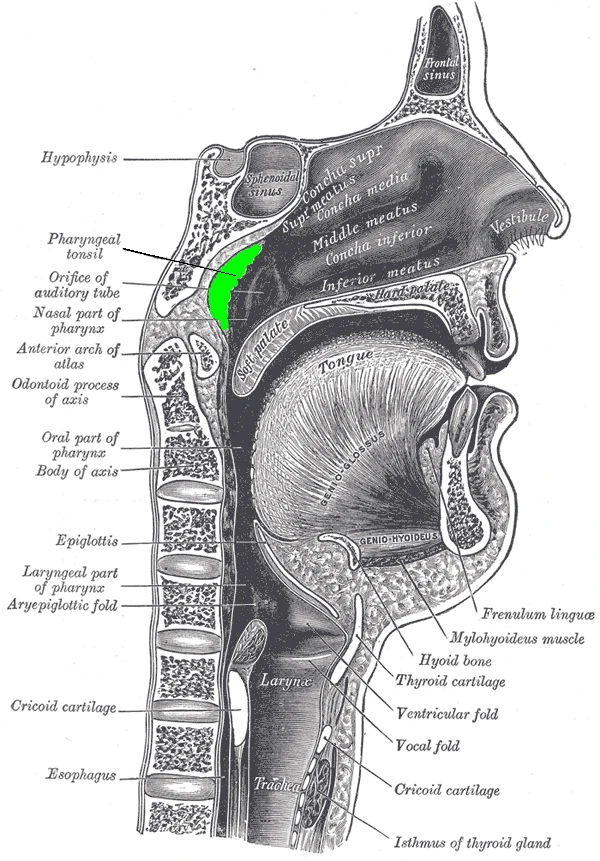 A midline cut through the nose, mouth and throat, with the pharyngeal tonsil, the adenoid, coloured green, Gray's Anatomy, 1918, figure 994Wikimedia Commons, Henry Vandyke Carter, Public domain (Gray994-adenoid.png)
Sources
- Susan Standring (ed.), Gray's Anatomy, 42nd ed. (2020), chapter on the pharynx.
- Henry Gray, Anatomy of the Human Body, 20th ed. (1918), section XI, The Pharynx.
Prev: Cells on patrolNext: Peyer's patches