Valves and pumps
Larger lymph vessels have valves every few millimetres, so a filled vessel looks like a string of beads. Each segment between two valves has smooth muscle in its wall. When lymph stretches a segment, it contracts and pushes the lymph past the next valve, several times a minute.
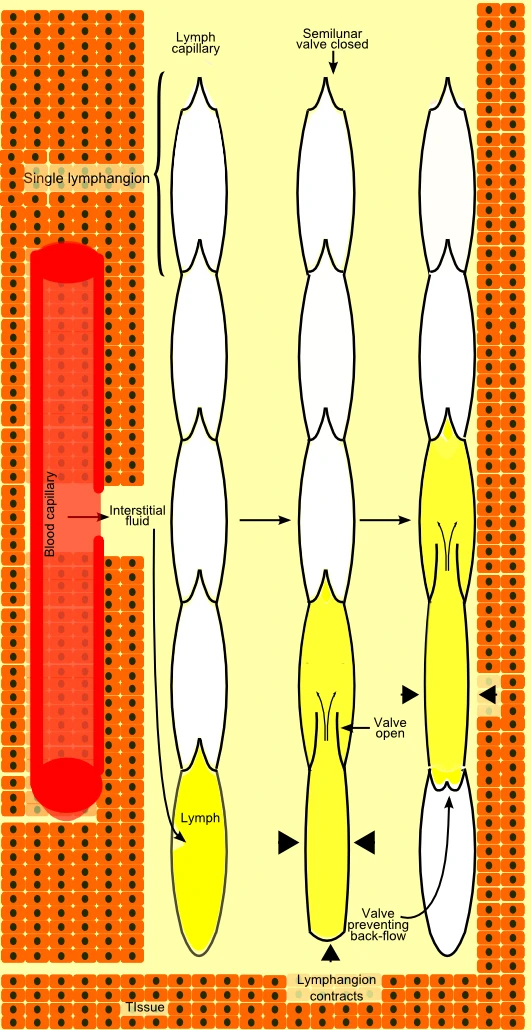 A lymph vessel as a chain of segments between valves: lymph fills a segment, the segment contracts, the valve ahead opens and the valve behind closesWikimedia Commons, KC Panchal, Public domain (Lymph vessel.png)
Outside forces help. Muscles squeeze the vessels as they work, arteries pulse beside them, and the diaphragm lowers the pressure in the chest with each breath, which draws lymph up the thoracic duct. At rest about 120 ml of lymph reaches the blood each hour. In hard exercise the flow can rise ten to thirty times.
Sources
- Arthur Guyton and John Hall, Textbook of Medical Physiology, 13th ed. (2016), ch. 16.
- Susan Standring (ed.), Gray's Anatomy, 42nd ed. (2020), ch. 6.
Prev: The first lymph vesselsNext: The thoracic duct