The abdominal wall
Between the ribs and the pelvis the wall of the abdomen is made of muscle. The rectus abdominis runs as a strap on each side of the midline, from the pubis to the cartilages of the fifth to seventh ribs. Usually three tendinous bands cross each strap, which gives a lean abdomen its six bulges.
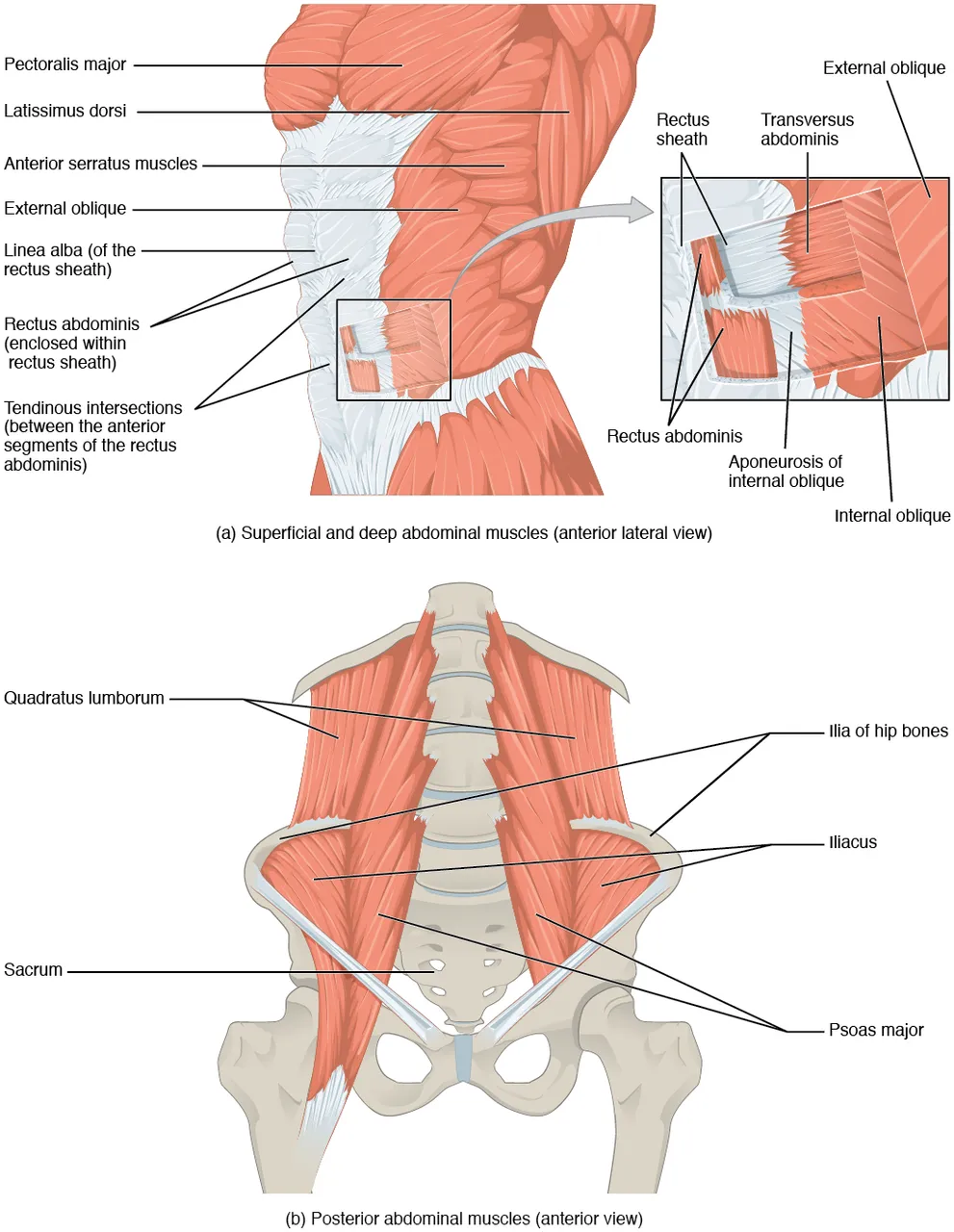 Muscles of the abdomen, the rectus abdominis beside the linea alba and the three flat muscles of the flank in front, and the psoas major, the iliacus and the quadratus lumborum on the back wall, OpenStax Anatomy and PhysiologyWikimedia Commons, OpenStax, CC BY 4.0 (1112 Muscles of the Abdomen.jpg)
On the sides the external oblique starts on the lower eight ribs. Its fibres run down and forward, like fingers in the front pockets, and end in a flat sheet of tendon, the aponeurosis. It covers the rectus, so the model shows it on the right only. The sheets of both sides meet at the linea alba.
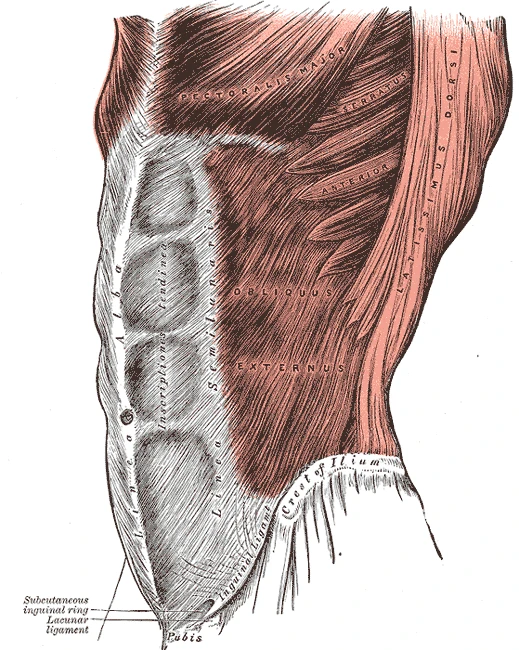 The external oblique on the left side of the abdomen, its aponeurosis covering the rectus abdominis as far as the linea alba, Gray's Anatomy, 1918, figure 392Wikimedia Commons, Henry Vandyke Carter, Public domain (Gray392.png)
These muscles bend the trunk forward and twist it, and they press on the organs inside. That pressure helps in coughing, vomiting, giving birth and passing stool, and it steadies the spine in lifting.
Sources
- Susan Standring (ed.), Gray's Anatomy, 42nd ed. (2020), chapter on the anterior abdominal wall.
Prev: BreathingNext: Three layers